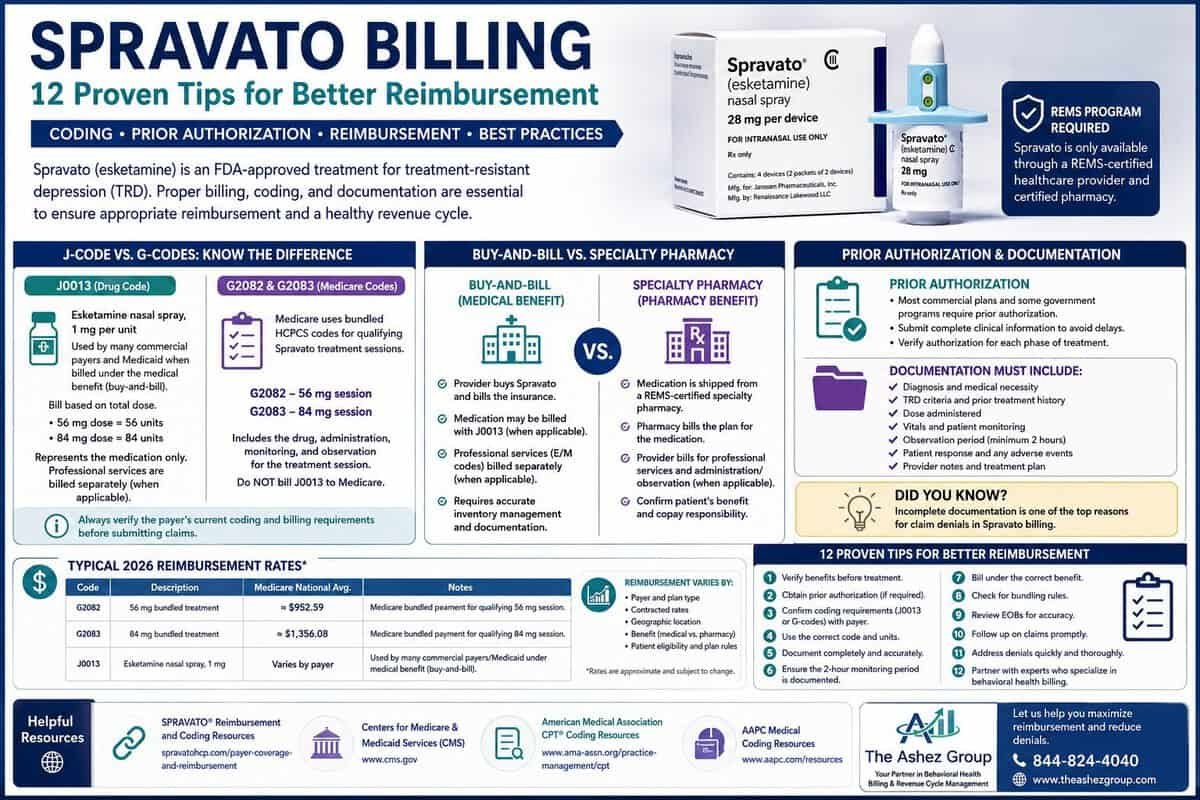
Spravato® (esketamine) has become an important treatment option for adults with treatment-resistant depression (TRD) and certain patients with major depressive disorder (MDD). While its clinical benefits are well established, Spravato Billing can be significantly more complex than billing for a standard office visit.
Unlike many medications administered in a physician’s office, Spravato often involves multiple billing components, including medication reimbursement, patient monitoring, evaluation and management (E/M) services when appropriate, prior authorization requirements, and payer-specific coverage policies.
Errors in coding, documentation, or benefit verification can lead to delayed payments, claim denials, or reimbursement reductions.
This guide explains the fundamentals of Spravato billing, common reimbursement challenges, and practical strategies to help behavioral health providers improve claim accuracy and optimize revenue cycle performance.
What Is Spravato?
Spravato® (esketamine) is a prescription nasal spray approved by the U.S. Food and Drug Administration (FDA) for specific indications, including treatment-resistant depression in adults and certain patients with major depressive disorder when used according to its approved labeling.
Because of its Risk Evaluation and Mitigation Strategy (REMS) program requirements, Spravato must be administered in a certified healthcare setting under the supervision of a qualified healthcare professional. Patients remain under observation after administration, making documentation and billing different from many routine psychiatric visits.
These unique clinical and administrative requirements make accurate Spravato billing essential for proper reimbursement.
Why Spravato Billing Is More Complex
Spravato treatment frequently involves several reimbursement components that may include:
- Medication reimbursement
- Administration and observation services
- Evaluation and Management (E/M) services when medically appropriate
- Prior authorization
- Benefit verification
- REMS program compliance
- Medical record documentation
Because coverage policies vary among Medicare, Medicaid, and commercial insurance plans, providers should verify payer-specific billing requirements before each course of treatment.
Medical Benefit vs. Pharmacy Benefit
One of the most important steps in Spravato billing is determining whether the patient’s insurance covers treatment under the medical benefit or the pharmacy benefit.
Medical Benefit
Some health plans reimburse Spravato through the patient’s medical benefit, where the provider administers the medication in the office and submits a medical claim according to the payer’s billing requirements.
Depending on the payer and contractual arrangement, providers may obtain the medication through an approved distribution process or follow other payer-directed procurement methods.
Pharmacy Benefit
Other health plans process Spravato through the pharmacy benefit.
In these cases, a specialty pharmacy may dispense the medication according to the payer’s requirements before the patient receives treatment in the provider’s office.
Because coverage models differ, confirming benefits before treatment helps prevent billing delays and unexpected patient financial responsibility. #spravato reimbursement rates
Common Spravato Billing Components
Although billing requirements vary by payer, providers commonly evaluate several billing elements during each treatment visit.
These may include:
Medication
Medication billing depends on the patient’s benefit structure, payer requirements, and applicable billing guidelines.
Observation Period
Patients are monitored after administration according to the approved treatment protocol. Documentation should accurately reflect the observation provided.
Evaluation and Management (E/M)
When a medically necessary and separately identifiable E/M service is performed and documented, providers may report the appropriate E/M code consistent with payer policies and coding guidelines.
Medical necessity and complete documentation remain essential.
Prior Authorization Is Often Required
Many insurance plans require prior authorization before approving Spravato treatment.
Typical authorization requests may include:
- Confirmed diagnosis
- Previous medication history
- Documentation supporting treatment-resistant depression or other covered indications
- Clinical notes
- Treatment plan
- Supporting medical necessity documentation
Incomplete authorization requests are one of the most common causes of treatment delays.
Practices should verify authorization requirements before scheduling treatment whenever possible.
Documentation Requirements
Accurate documentation plays a critical role in successful Spravato billing.
Medical records should clearly document:
- Patient diagnosis
- Medical necessity
- Treatment plan
- Date of service
- Medication administered
- Observation period
- Patient response
- Provider notes
- Any separately identifiable E/M service, when applicable
Strong documentation supports accurate coding and reduces the likelihood of denials or requests for additional information.
Common Billing Challenges
Behavioral health practices frequently encounter reimbursement issues such as:
- Missing prior authorization
- Incomplete documentation
- Incorrect benefit verification
- Coding inconsistencies
- Delayed claim submission
- Payer-specific policy differences
- Inadequate follow-up on denied or pending claims
Developing standardized billing workflows can help reduce administrative burdens and improve reimbursement consistency.
Why Revenue Cycle Management Matters
Because Spravato treatment often involves multiple administrative and reimbursement steps, strong revenue cycle management is essential.
Effective processes help practices:
- Verify benefits before treatment
- Obtain required authorizations
- Improve documentation quality
- Submit accurate claims
- Reduce denials
- Track reimbursements
- Improve cash flow
A proactive revenue cycle strategy helps behavioral health practices spend less time resolving billing issues and more time focusing on patient care.
Understanding Spravato Billing Codes
One of the most confusing aspects of Spravato billing is determining whether to bill the medication using a J-code, a G-code, or Evaluation and Management (E/M) codes. The correct approach depends on the patient’s payer, benefit design, and how the medication is obtained. Always verify the payer’s current billing requirements before claim submission.
J-Code vs. G-Code: What’s the Difference?
| J-Code (J0013) | G-Codes (G2082 & G2083) |
|---|---|
| Represents the Spravato medication (1 mg per unit). | Medicare HCPCS codes that bundle the drug with administration/observation services for eligible treatment sessions. |
| Commonly used by many Medicaid and commercial payers under the medical benefit. | Primarily used for Medicare beneficiaries and certain non-Medicare payers that specifically require G-codes. |
| Bills the drug only. Professional services are generally reported separately when appropriate. | Represents a bundled treatment session rather than billing the drug separately. |
| Units are reported based on the dose administered. | Code selection depends on the treatment dose and payer guidance. |
Effective January 1, 2026, J0013 replaced the previous temporary HCPCS code for many payers. Medicare continues to use G2082 and G2083 to report qualifying bundled Spravato treatment sessions.
SPRAVATO® Reimbursement and Coding Resources
J0013 Explained
HCPCS J0013
Descriptor:
Esketamine nasal spray, 1 mg
Because the code represents 1 mg, billing units are based on the total milligrams administered.
Common Unit Examples
- 56 mg dose = 56 units of J0013
- 84 mg dose = 84 units of J0013
J0013 represents the medication itself. When appropriate under payer policy, professional services such as Evaluation and Management (E/M) are reported separately. Always follow the payer’s billing instructions.
G2082 vs. G2083
For Medicare beneficiaries and payers that require bundled HCPCS reporting:
G2082
Used for qualifying 56 mg Spravato treatment sessions.
G2083
Used for qualifying 84 mg Spravato treatment sessions.
Unlike J0013, these HCPCS codes represent a bundled treatment session under applicable Medicare rules rather than billing the medication separately. #codes for spravato #billing and coding esketamine #requirements for spravato
Buy-and-Bill vs. Specialty Pharmacy
Buy-and-Bill
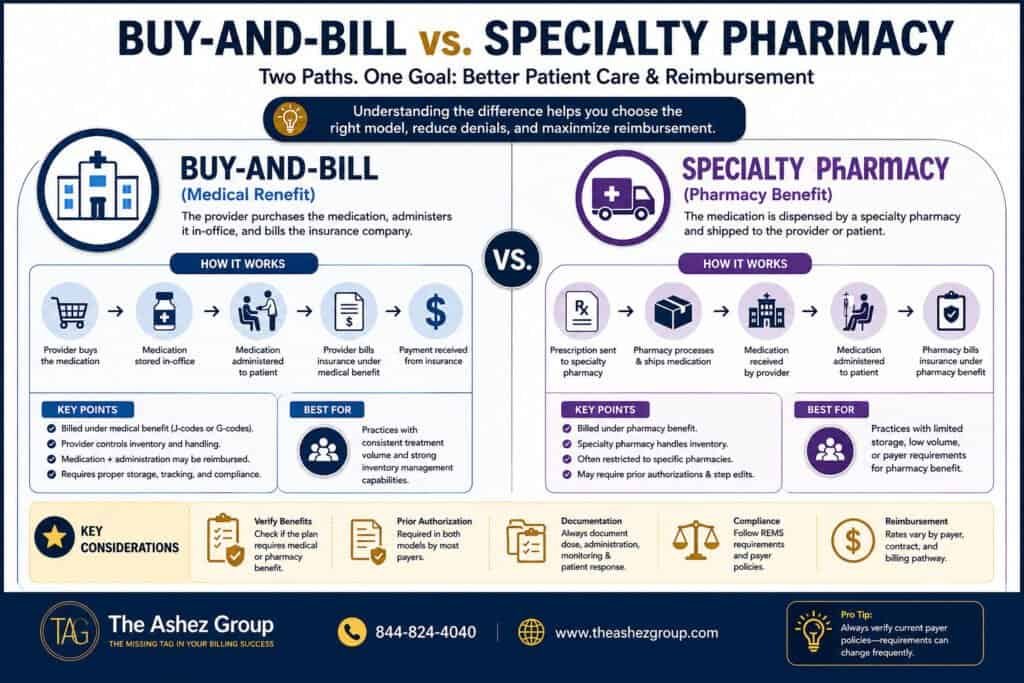
Under the buy-and-bill model:
- The provider purchases Spravato.
- The medication is administered in the office.
- The provider submits the claim according to the payer’s requirements.
- Reimbursement may include the medication and professional services depending on the payer’s billing methodology.
For many commercial and Medicaid plans, this may involve J0013 plus separately reportable professional services when appropriate. Medicare and certain other payers may instead require bundled G-codes.
REMS-Certified Specialty Pharmacy
Some insurance plans require Spravato to be supplied through a REMS-certified specialty pharmacy.
In this model:
- The pharmacy supplies and bills for the medication when required by the payer.
- The provider generally bills only the professional services that are appropriate under payer policy.
Coverage and billing responsibilities vary by payer and benefit design.
Typical Billing Workflow
Step 1
Verify insurance benefits.
Step 2
Determine whether coverage is under:
- Medical benefit
- Pharmacy benefit
Step 3
Obtain prior authorization if required.
Step 4
Confirm whether the payer requires:
- J0013
- G2082
- G2083
- Other payer-specific billing methodology
Step 5
Document:
- Diagnosis
- Medical necessity
- Dose administered
- Observation period
- Patient response
- Provider notes
Step 6
Submit the claim and review the Explanation of Benefits (EOB) for reimbursement accuracy.
Common Spravato Billing Mistakes
Practices frequently experience denials because they:
❌ Bill under the wrong benefit
❌ Use incorrect HCPCS units
❌ Miss prior authorization
❌ Fail to document the observation period
❌ Submit incomplete clinical documentation
❌ Bill bundled and separate services incorrectly
❌ Do not verify payer-specific coding requirements
Billing Tips
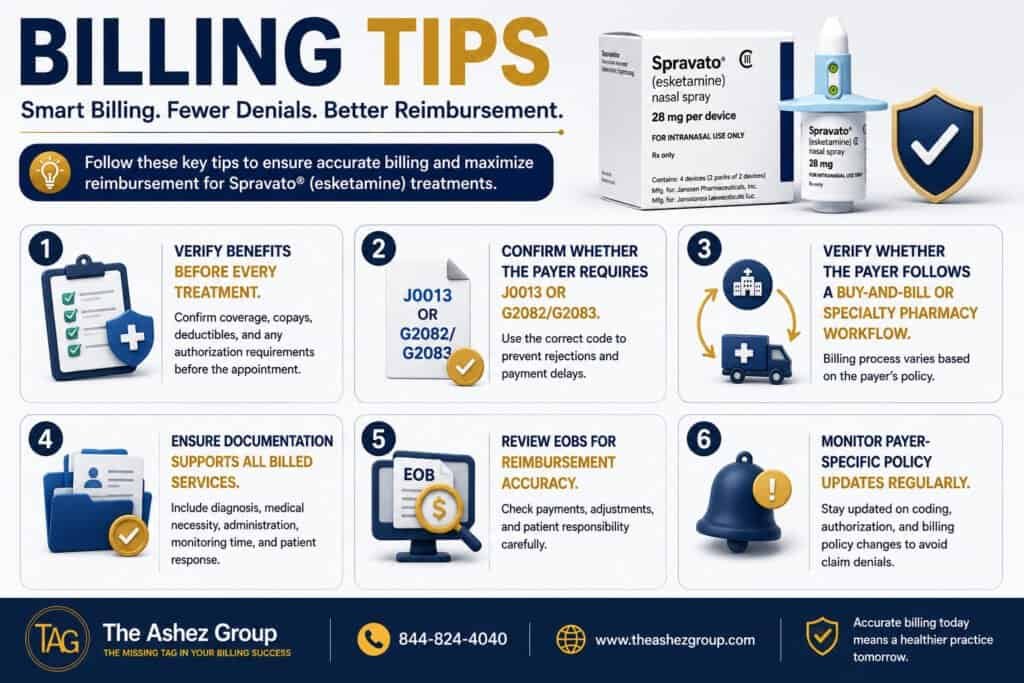
✔ Verify benefits before every treatment.
✔ Confirm whether the payer requires J0013 or G2082/G2083.
✔ Verify whether the payer follows a buy-and-bill or specialty pharmacy workflow.
✔ Ensure documentation supports all billed services.
✔ Review EOBs for reimbursement accuracy.
✔ Monitor payer-specific policy updates regularly.
Final Thoughts
Successful Spravato billing requires accurate coding, complete documentation, benefit verification, prior authorization management, and ongoing reimbursement monitoring. Because payer policies differ, providers should verify current billing requirements before each course of treatment and periodically review official payer guidance and manufacturer reimbursement resources. A standardized billing workflow helps reduce denials, improve reimbursement accuracy, and support a healthier revenue cycle.
What is Spravato billing?
Spravato billing is the process of submitting claims for esketamine treatment, including the medication, applicable professional services, prior authorization requirements, and payer-specific reimbursement guidelines.
Is Spravato billed under the medical benefit or pharmacy benefit?
It depends on the insurance plan. Some payers cover Spravato under the medical benefit (buy-and-bill), while others require the medication to be supplied through a specialty pharmacy under the pharmacy benefit.
What is HCPCS J0013?
J0013 represents Esketamine nasal spray, 1 mg. Units are billed according to the total dose administered when the payer requires billing the medication with J0013.
What is the difference between J0013 and G2082/G2083?
J0013 bills the medication itself. G2082 and G2083 are Medicare HCPCS codes that represent bundled Spravato treatment sessions for qualifying doses under applicable Medicare billing rules.
Does Spravato require prior authorization?
In many cases, yes. Most commercial insurance plans and some government programs require prior authorization before treatment begins.
Can Spravato claims be denied?
Yes. Common reasons include missing prior authorization, incomplete documentation, incorrect coding, billing under the wrong benefit, or payer-specific policy requirements.
How can practices improve Spravato reimbursement?
Verify benefits before treatment, obtain prior authorization when required, maintain complete documentation, submit accurate claims, and review EOBs for reimbursement accuracy.
How can The Ashez Group help with Spravato billing?
The Ashez Group provides behavioral health billing, prior authorization support, insurance verification, denial management, and revenue cycle management services to help practices optimize Spravato reimbursement and reduce claim denials.
Simplify Your Spravato Billing Process
Spravato reimbursement can be complex, but it doesn’t have to slow down your practice. From benefit verification and prior authorization to claim submission and denial management, a streamlined billing process can improve cash flow and reduce administrative burdens.
The Ashez Group specializes in behavioral health revenue cycle management, helping practices navigate payer requirements, improve reimbursement accuracy, and maximize collections.
📞 844-824-4040
Focus on patient care—we’ll help optimize your revenue cycle.