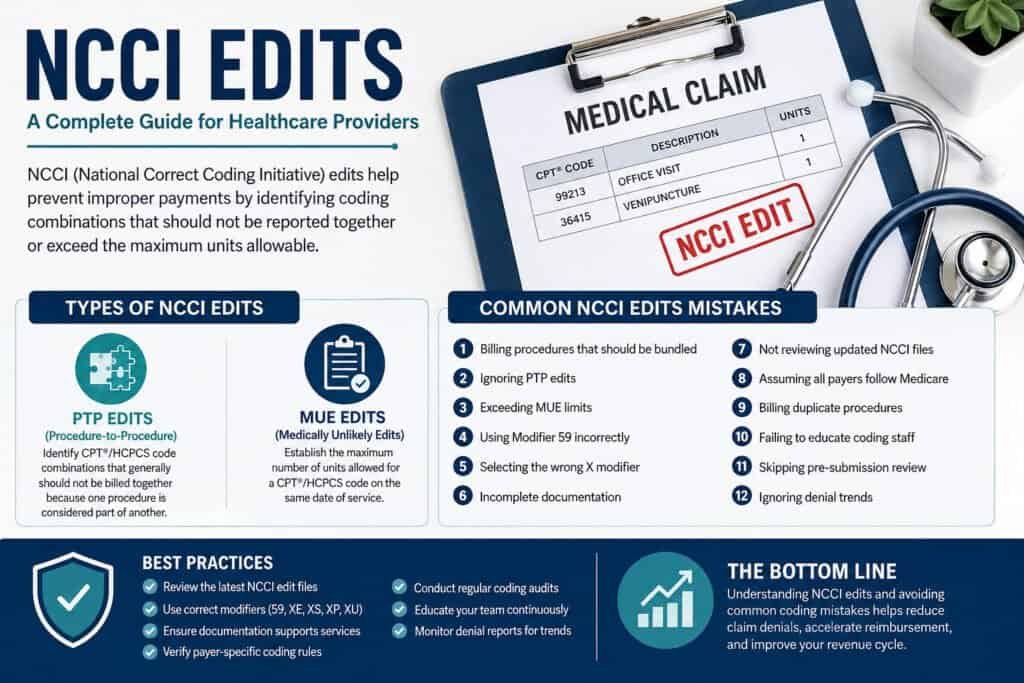
Medical coding accuracy plays a critical role in ensuring healthcare providers receive proper reimbursement while maintaining compliance with payer guidelines. One of the most important coding compliance tools used by Medicare and many commercial insurance companies is the National Correct Coding Initiative (NCCI).
NCCI Edits are designed to prevent incorrect coding, reduce improper payments, and ensure that healthcare services are billed according to nationally recognized coding standards. When coding errors occur, claims may be denied, bundled, or reimbursed incorrectly—leading to delayed payments and unnecessary administrative work.
Whether you’re a physician, medical coder, biller, or practice manager, understanding NCCI ptp edits can help you reduce claim denials, improve coding accuracy, and strengthen your revenue cycle.
In this guide, we’ll explain what NCCI edits are, how they work, and the most common coding mistakes healthcare providers should avoid. #procedure lookup ncci implementation #national correct coding initiative
What Are NCCI Edits?
The National Correct Coding Initiative (NCCI) is a program developed by the Centers for Medicare & Medicaid Services (CMS) to promote correct coding methodologies and prevent improper reimbursement.
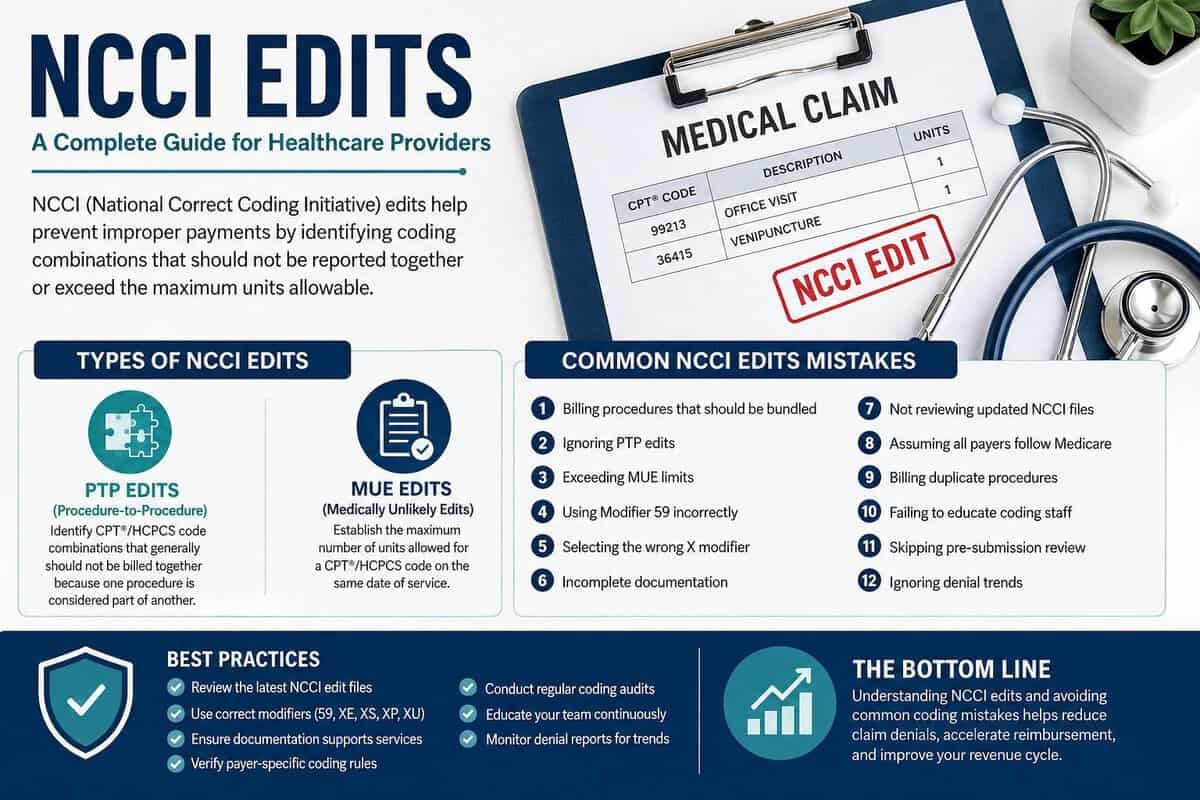
NCCI edits identify combinations of CPT® and HCPCS codes that generally should not be reported together because they represent services that are:
- Included in another procedure
- Mutually exclusive
- Components of a more comprehensive service
- Not separately reimbursable under Medicare coding policies
Many commercial insurance companies also incorporate NCCI edit principles into their claims processing systems.
Why Were NCCI Edits Created?
Before NCCI was introduced, inconsistent coding practices often resulted in duplicate billing, overpayments, and unnecessary claim reviews.
CMS developed NCCI to:
- Improve coding accuracy
- Prevent duplicate reimbursement
- Reduce billing errors
- Promote consistent coding nationwide
- Minimize fraud, waste, and abuse
- Support Medicare payment integrity
Today, NCCI edits remain one of the most important compliance tools in medical billing and coding.
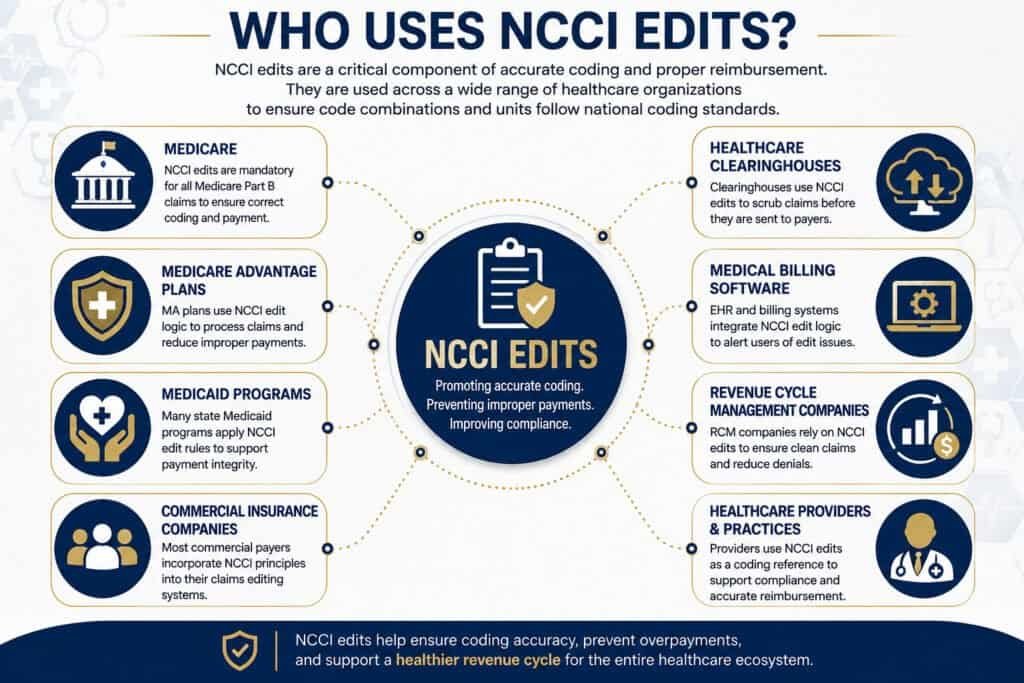
Who Uses NCCI Edits?
Although NCCI was developed by CMS for Medicare, its influence extends far beyond federal healthcare programs.
Organizations that commonly rely on NCCI edit principles include:
- Medicare
- Medicare Advantage plans
- Medicaid programs (state-specific implementation)
- Commercial insurance companies
- Healthcare clearinghouses
- Medical billing software
- Revenue cycle management platforms
Because payer policies differ, providers should always verify individual insurance requirements in addition to following NCCI guidance.
National Correct Coding Initiative (NCCI)
Types of NCCI Edits
NCCI consists of two primary edit categories.
1. Procedure-to-Procedure (PTP) Edits
PTP edits determine whether two CPT® or HCPCS codes should be billed together during the same patient encounter.
If one procedure is considered part of another, the claim may bundle the services or deny payment for one of the codes unless payer policy allows separate reporting under specific circumstances.
PTP edits help prevent duplicate reimbursement for services that are normally performed together.
2. Medically Unlikely Edits (MUEs)
Medically Unlikely Edits (MUEs) establish the maximum number of units that are generally expected for a particular CPT® or HCPCS code on a single date of service.
Submitting units above the MUE value may result in claim denials or requests for additional documentation unless medically justified according to payer policy.
MUEs help identify unusual billing patterns while promoting consistent coding practices.
Why NCCI Edits Matter
Ignoring NCCI edits can create significant operational and financial challenges for healthcare practices.
Common consequences include:
- Claim denials
- Bundled payments
- Reduced reimbursement
- Payment delays
- Increased appeals
- Compliance risks
- Additional administrative work
Understanding NCCI edits before claims are submitted helps improve first-pass acceptance rates and supports a healthier revenue cycle.
Common Situations Where NCCI Edits Apply
Healthcare providers frequently encounter NCCI edits when:
- Multiple procedures are performed during the same visit.
- Similar CPT® codes are billed together.
- Separate procedures are components of a more comprehensive service.
- Multiple units exceed established MUE limits.
- Modifiers are used incorrectly.
- Surgical procedures include services that are already part of the global package.
Recognizing these situations before claim submission can help reduce avoidable denials and coding errors.
Procedure-to-Procedure (PTP) Edits vs. Medically Unlikely Edits (MUEs)
Understanding the difference between Procedure-to-Procedure (PTP) edits and Medically Unlikely Edits (MUEs) is essential for accurate coding and successful claim submission. Although both are part of the National Correct Coding Initiative (NCCI), they serve different purposes in preventing improper reimbursement.
| PTP Edits | MUE Edits |
|---|---|
| Determine whether two CPT® or HCPCS codes can be billed together. | Limit the maximum number of units billed for a CPT® or HCPCS code on the same date of service. |
| Focus on code combinations. | Focus on billing units. |
| Help prevent duplicate payment for related procedures. | Help identify excessive or unlikely unit reporting. |
| May allow separate billing with an appropriate modifier when supported by documentation and payer policy. | Units exceeding the MUE value may require medical necessity documentation or may be denied, depending on payer policy. |
| Commonly affect surgical and procedural services. | Apply across many medical specialties and services. |
Modifier 59 vs. XE, XS, XP & XU
One of the most common reasons providers receive NCCI denials is the incorrect use of modifiers.
Modifier 59 is used to identify a distinct procedural service when separate reporting is appropriate and supported by documentation.
CMS also recognizes the X{EPSU} modifiers, which provide additional specificity.
Modifier XE
Separate Encounter
Used when services are performed during a separate patient encounter on the same date of service.
Modifier XS
Separate Structure
Used when procedures are performed on different organs or anatomical structures.
Modifier XP
Separate Practitioner
Used when a different healthcare provider performs the service.
Modifier XU
Unusual Non-Overlapping Service
Used when a service does not overlap with the usual components of another procedure.
Whenever possible, Medicare recommends using the appropriate X{EPSU} modifier instead of Modifier 59 when it better describes the circumstances. Providers should also verify payer-specific modifier policies, as commercial insurers may have different requirements.
12 Costly NCCI Coding Mistakes
Healthcare organizations frequently experience denials because of avoidable coding errors.
1. Billing procedures that should be bundled
Submitting separate claims for services that are considered components of another procedure.
2. Ignoring PTP edits
Failing to review Procedure-to-Procedure edits before claim submission.
3. Exceeding MUE limits
Billing more units than generally allowed without sufficient medical necessity or payer support.
4. Using Modifier 59 incorrectly
Applying Modifier 59 simply to bypass an edit rather than to accurately represent a distinct service.
5. Selecting the wrong X modifier
Using XE, XS, XP, or XU when documentation does not support the modifier selected.
6. Incomplete documentation
Missing operative notes or clinical documentation that support separately reportable services.
7. Not reviewing updated NCCI files
CMS updates NCCI edit files regularly. Using outdated information can increase denials.
8. Assuming all commercial payers follow Medicare exactly
Many commercial insurers apply NCCI principles but may have their own coding policies.
9. Billing duplicate procedures
Accidentally submitting duplicate CPT® or HCPCS codes for the same encounter.
10. Failing to educate coding staff
Coding guidelines evolve regularly. Ongoing education helps maintain compliance and accuracy.
11. Skipping pre-submission claim review
Submitting claims without reviewing NCCI edits increases preventable denials.
12. Ignoring denial trends
Repeated NCCI denials often indicate workflow issues that should be investigated and corrected.
How to Check NCCI Edits Before Billing
Reducing NCCI-related denials starts with reviewing edits before claims are submitted.
Best practices include:
✔ Review the latest CMS NCCI edit files.
✔ Use coding software that incorporates current NCCI edits.
✔ Verify payer-specific coding requirements.
✔ Confirm modifier usage is supported by documentation.
✔ Conduct internal coding audits regularly.
✔ Educate providers and coding staff on annual coding updates.
How NCCI Edits Impact Revenue Cycle Management
NCCI edits influence every stage of the revenue cycle.
When claims fail NCCI edits, practices often experience:
- Increased claim denials
- Payment delays
- More appeals
- Higher administrative costs
- Reduced staff productivity
- Slower cash flow
By implementing strong coding compliance processes, practices can improve clean claim rates, reduce denials, and strengthen overall financial performance.
Best Practices for NCCI Compliance
Healthcare organizations can reduce coding errors by following these best practices:
- Maintain current CPT® and HCPCS coding resources.
- Review CMS NCCI quarterly updates.
- Perform regular coding audits.
- Train coding and billing staff on modifier usage.
- Monitor denial reports for recurring NCCI issues.
- Verify payer-specific billing guidelines.
- Keep clinical documentation complete and accurate.
Final Thoughts
NCCI edits are designed to promote accurate coding, prevent improper reimbursement, and improve compliance across the healthcare industry. Understanding the difference between Procedure-to-Procedure (PTP) edits and Medically Unlikely Edits (MUEs)—along with the proper use of modifiers such as 59, XE, XS, XP, and XU—can significantly reduce preventable claim denials.
By staying current with CMS updates, maintaining thorough documentation, and performing routine coding reviews, healthcare providers can improve claim accuracy, accelerate reimbursement, and build a stronger revenue cycle. For practices looking to reduce denials and optimize coding compliance, investing in education and proactive auditing is a practical step toward long-term financial success. #TheAshezGroup #TheAshezDigitalSolutions
What are NCCI edits?
NCCI edits are coding rules developed by CMS to prevent improper payments by identifying CPT® and HCPCS code combinations or units that should not be billed together.
What is the difference between PTP edits and MUE edits?
PTP edits determine whether two procedure codes can be billed together, while MUE edits limit the maximum number of units that can be billed for a code on the same date of service.
Do commercial insurance companies use NCCI edits?
Yes. Many commercial insurance companies incorporate NCCI edit principles into their claims processing, although payer-specific policies may vary.
Can Modifier 59 override an NCCI edit?
Sometimes. Modifier 59 should only be used when documentation supports a distinct procedural service and payer guidelines allow separate reimbursement.
How often are NCCI edits updated?
CMS updates the NCCI edit files quarterly, so coding and billing teams should review the latest updates regularly.
Where can I check NCCI edits?
The latest NCCI edit files are available on the CMS website and are also integrated into many coding and billing software platforms.
7. Why do NCCI edits cause claim denials?
Claims may be denied if procedure codes are billed together incorrectly, units exceed MUE limits, or modifiers are used improperly.
How can healthcare practices reduce NCCI-related denials?
Regular coding audits, accurate documentation, current CMS updates, proper modifier usage, and ongoing staff education can significantly reduce NCCI-related claim denials.