Behavioral health billing is one of the most specialized areas of medical coding. Unlike many other specialties, psychiatric services rely heavily on time-based CPT® codes, detailed documentation, medical necessity, and accurate code selection. Even small coding mistakes can result in claim denials, delayed reimbursement, payer audits, or compliance concerns.
Whether you’re a psychiatrist, psychologist, PMHNP, LCSW, LPC, LMFT, or behavioral health practice manager, understanding proper Behavioral Health CPT Coding is essential for maintaining compliance and protecting your practice’s revenue.
In this guide, we’ll review the most common CPT coding mistakes in behavioral health, explain when commonly used psychiatric codes apply, and share practical tips to improve coding accuracy and reimbursement. #behavioral health coding guide
Why Behavioral Health CPT Coding Matters
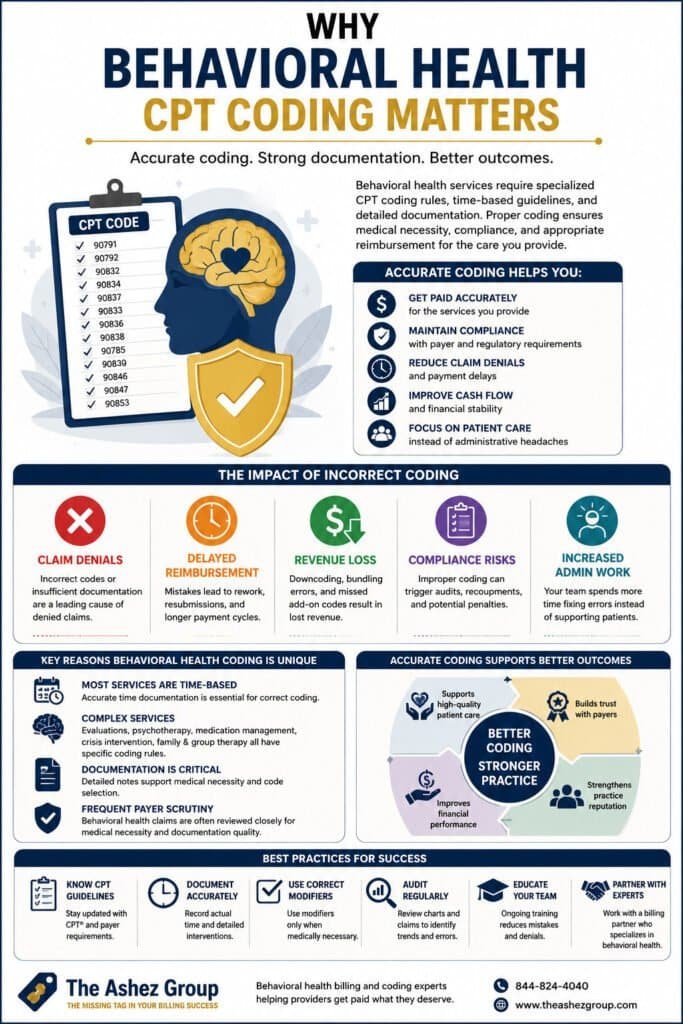
Behavioral health services often involve evaluation, psychotherapy, medication management, crisis intervention, family therapy, and group therapy. Each service has specific CPT coding rules and documentation requirements.
Selecting the wrong code—or failing to support it with proper documentation—may lead to:
- Claim denials
- Downcoded services
- Delayed reimbursement
- Payment recoupments
- Compliance audits
- Increased administrative workload
Accurate coding helps ensure providers are reimbursed appropriately while demonstrating medical necessity and compliance with payer guidelines.
Behavioral health providers should follow current CPT® coding guidelines and applicable CMS billing policies to ensure accurate coding and compliant reimbursement.
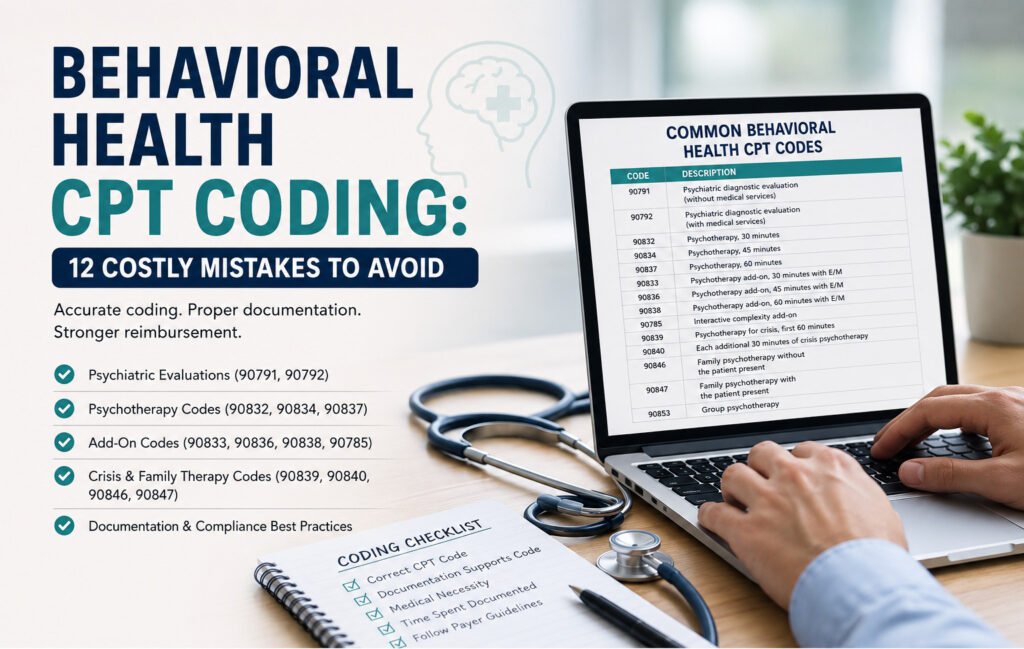
Common Behavioral Health CPT Codes
Below are some of the most frequently reported CPT codes in behavioral health.
| CPT Code | Description |
|---|---|
| 90791 | Psychiatric diagnostic evaluation (without medical services) |
| 90792 | Psychiatric diagnostic evaluation with medical services |
| 90832 | Psychotherapy, 30 minutes |
| 90834 | Psychotherapy, 45 minutes |
| 90837 | Psychotherapy, 60 minutes |
| 90833 | Psychotherapy add-on, 30 minutes with E/M |
| 90836 | Psychotherapy add-on, 45 minutes with E/M |
| 90838 | Psychotherapy add-on, 60 minutes with E/M |
| 90785 | Interactive complexity add-on |
| 90839 | Psychotherapy for crisis, first 60 minutes |
| 90840 | Each additional 30 minutes of crisis psychotherapy |
| 90846 | Family psychotherapy without the patient present |
| 90847 | Family psychotherapy with the patient present |
| 90853 | Group psychotherapy |
Understanding when each code applies is the first step toward reducing behavioral health billing errors.
Documentation Is Just as Important as Coding
Selecting the correct CPT code alone isn’t enough.
Behavioral health documentation should clearly support:
- Medical necessity
- Diagnosis
- Treatment goals
- Time spent
- Therapeutic interventions
- Patient response
- Progress toward treatment objectives
Incomplete documentation is one of the most common reasons psychiatric claims are denied or downcoded during payer review.
Time-Based Coding Rules
Most psychotherapy codes are based on the amount of face-to-face psychotherapy provided.
Providers should document the actual psychotherapy time rather than estimating session length.
For example:
- 90832 generally represents approximately 16–37 minutes of psychotherapy.
- 90834 generally represents approximately 38–52 minutes.
- 90837 generally represents 53 minutes or longer.
Accurate time documentation helps support code selection and reduces the risk of payer audits or reimbursement disputes.
Choosing Between 90791 and 90792
One of the most common coding questions involves selecting the appropriate psychiatric diagnostic evaluation code.
CPT 90791
Used for psychiatric diagnostic evaluations without medical services.
Typically reported by psychologists, therapists, counselors, or other qualified behavioral health professionals who are not providing medical evaluation or medication management as part of the encounter.
CPT 90792
Used for psychiatric diagnostic evaluations with medical services.
Typically reported by psychiatrists, psychiatric nurse practitioners (PMHNPs), or other qualified medical professionals when the evaluation includes medical assessment, medication review, or other medically necessary services.
Selecting the appropriate evaluation code depends on the services actually provided and documented—not simply the provider’s specialty.
12 Costly Behavioral Health CPT Coding Mistakes
Behavioral health billing requires more than selecting the correct CPT® code. Accurate documentation, proper code selection, and compliance with payer guidelines all play a critical role in successful reimbursement.
Here are the most common coding mistakes that lead to denials, audits, and lost revenue.
1. Choosing the Wrong Evaluation Code (90791 vs. 90792)
One of the most common behavioral health billing errors is selecting the wrong psychiatric diagnostic evaluation code.
- 90791 is used for a psychiatric diagnostic evaluation without medical services.
- 90792 is reported when the evaluation includes medical services, such as medication management or a medical assessment, performed by a qualified medical provider.
Always code based on the services documented—not simply the provider’s credentials.
2. Selecting the Wrong Time-Based Psychotherapy Code
Psychotherapy codes are determined by the amount of psychotherapy provided during the encounter.
Common psychotherapy CPT codes include:
- 90832 – Approximately 16–37 minutes
- 90834 – Approximately 38–52 minutes
- 90837 – 53 minutes or longer
Estimating time instead of documenting actual psychotherapy time can increase the risk of payer denials and audits.
3. Billing E/M and Psychotherapy Incorrectly
Psychiatrists and psychiatric nurse practitioners frequently provide medication management and psychotherapy during the same visit.
In these cases, providers may report an appropriate Evaluation and Management (E/M) code together with a psychotherapy add-on code only when both services are separately identifiable and fully documented.
Documentation should clearly distinguish:
- Medical evaluation
- Medication management
- Psychotherapy time
- Clinical decision-making
4. Using Psychotherapy Add-On Codes Incorrectly
Behavioral health providers often misuse psychotherapy add-on codes.
Common add-on codes include:
- 90833 – Psychotherapy, 30 minutes with E/M
- 90836 – Psychotherapy, 45 minutes with E/M
- 90838 – Psychotherapy, 60 minutes with E/M
These codes cannot be billed alone. They must be reported with an appropriate E/M service and supported by documentation of both services. #psychotherapy minutes with patient #the billing and documentation #webinar on the billing #documentation update for psychiatrists
5. Reporting Interactive Complexity (90785) Without Documentation
90785 is an add-on code used when communication factors significantly complicate the delivery of psychiatric services.
Examples may include:
- Involvement of third parties
- Communication barriers
- High emotional reactivity
- Managing maladaptive behaviors
Simply having a difficult patient does not justify reporting 90785. Documentation must explain why interactive complexity was present.
6. Incorrectly Billing Crisis Psychotherapy
Crisis psychotherapy requires immediate assessment and intervention for a patient experiencing an urgent behavioral health crisis.
Common codes include:
- 90839 – First 60 minutes of crisis psychotherapy
- 90840 – Each additional 30 minutes
Routine psychotherapy visits should not be coded as crisis services unless documentation supports the patient’s immediate crisis and the intensive services provided.
7. Confusing Family Therapy Codes
Behavioral health practices sometimes report the wrong family therapy code.
- 90846 – Family psychotherapy without the patient present
- 90847 – Family psychotherapy with the patient present
Documentation should clearly indicate whether the patient participated in the session.
8. Billing Group Therapy Incorrectly
90853 is used for group psychotherapy.
Common mistakes include:
- Reporting individual psychotherapy codes instead of group therapy
- Billing multiple psychotherapy codes for the same group session
- Failing to document the patient’s participation and therapeutic goals
9. Inadequate Documentation
Proper documentation remains one of the most important components of behavioral health billing.
Clinical records should include:
- Diagnosis
- Medical necessity
- Session length
- Therapeutic interventions
- Patient response
- Treatment goals
- Progress toward treatment objectives
- Follow-up plan
Incomplete documentation increases the likelihood of denials and payer audits.
10. Incorrect Telehealth Coding
Behavioral health services are frequently delivered through telehealth.
Coding errors may include:
- Incorrect Place of Service (POS)
- Missing required telehealth modifiers
- Failure to document patient consent
- Not following payer-specific telehealth policies
Because telehealth requirements vary by payer, providers should verify current billing guidelines before claim submission.
11. Ignoring Payer-Specific Billing Policies
Although CPT® provides standardized coding guidance, insurance companies often have their own coverage policies.
Differences may include:
- Prior authorization requirements
- Frequency limitations
- Telehealth rules
- Documentation standards
- Reimbursement policies
Reviewing payer-specific guidelines before billing helps reduce avoidable denials.
12. Failing to Perform Regular Coding Audits
Even experienced behavioral health practices benefit from routine coding audits.
Audits help identify:
- Coding inconsistencies
- Documentation deficiencies
- Repeated denial trends
- Compliance risks
- Staff training opportunities
Regular internal reviews support accurate coding and strengthen long-term revenue cycle performance.
Best Practices for Behavioral Health CPT Coding
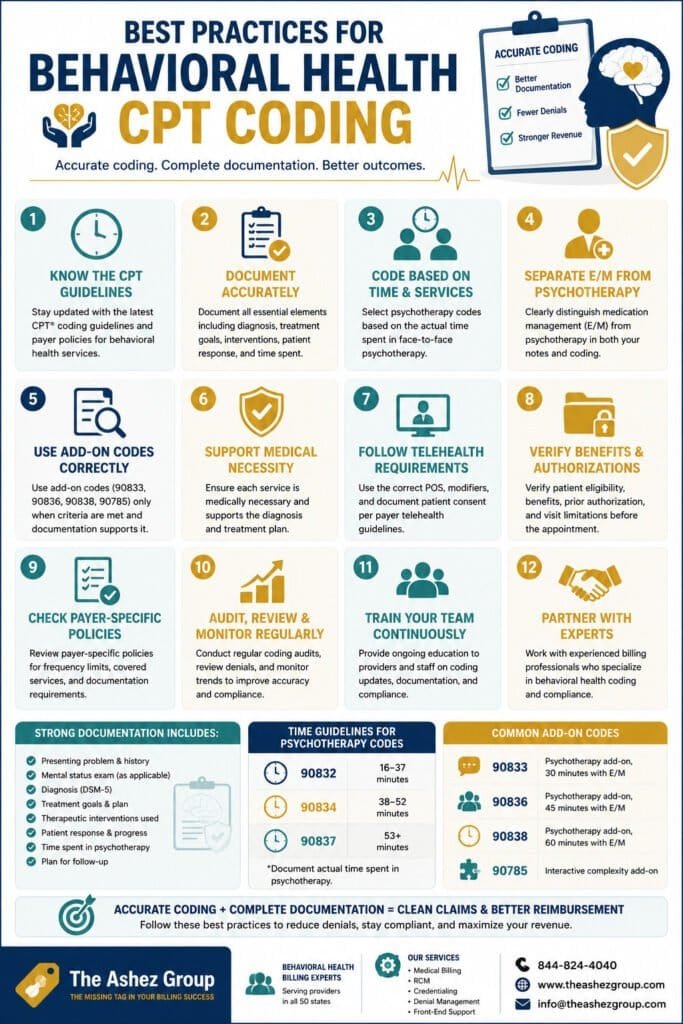
Healthcare organizations can improve coding accuracy by following these best practices:
✔ Document psychotherapy time accurately.
✔ Select CPT codes based on services performed—not assumptions.
✔ Distinguish psychotherapy from medication management in the medical record.
✔ Verify payer-specific billing policies before submitting claims.
✔ Stay current with CPT® and payer updates.
✔ Conduct routine coding audits.
✔ Educate providers and billing staff on documentation requirements.
✔ Monitor denial trends and address recurring issues.
Final Thoughts
Behavioral health coding requires careful attention to CPT® guidelines, documentation standards, and payer-specific policies. Mistakes such as choosing the wrong evaluation code, misreporting psychotherapy time, incorrectly billing add-on services, or overlooking documentation requirements can lead to denied claims, delayed reimbursement, and compliance risks.
By understanding the most common behavioral health CPT coding errors and implementing consistent documentation and auditing practices, healthcare providers can improve claim accuracy, reduce denials, and strengthen their revenue cycle. Investing in coding education and compliance today helps protect both reimbursement and the long-term success of your practice.
What is Behavioral Health CPT Coding?
Behavioral Health CPT Coding is the process of selecting the correct CPT® codes for psychiatric evaluations, psychotherapy, medication management, family therapy, group therapy, and other behavioral health services to ensure accurate reimbursement.
What are the most commonly used Behavioral Health CPT codes?
The most commonly used Behavioral Health CPT codes are:
- 90791: Psychiatric diagnostic evaluation
- 90792: Psychiatric diagnostic evaluation with medical services
- 90832: Psychotherapy, 30 minutes
- 90834: Psychotherapy, 45 minutes
- 90837: Psychotherapy, 60 minutes
- 90846: Family psychotherapy (without patient present)
- 90847: Family psychotherapy (with patient present)
- 96130: Psychological testing evaluation services, first hour
- 96131: Psychological testing evaluation services, each additional hour
- 96136: Psychological or neuropsychological test administration and scoring by a technician, first hour
- 96137: Psychological or neuropsychological test administration and scoring by a technician, each additional hour
How do I choose the correct psychotherapy CPT code?
To choose the correct psychotherapy CPT code, consider the following:
**Identify the Service**: Determine if the session is for individual therapy, group therapy, or family therapy.
**Session Length**: Check the duration of the session. Codes vary by time increments (e.g., 30 minutes, 60 minutes).
**Treatment Type**: Classify the therapy type (e.g., cognitive behavioral therapy, psychodynamic therapy).
**Select the Code**:
- 90832: Individual psychotherapy, 30 minutes
- 90834: Individual psychotherapy, 45 minutes
- 90837: Individual psychotherapy, 60 minutes
- 90847: Family psychotherapy, 50 minutes (with patient present)
- 90846: Family psychotherapy, 50 minutes (without patient present)
**Check Payer Guidelines**: Verify with insurance providers for any specific coding requirements.
Always ensure documentation supports the selected code.
Can psychotherapy and medication management be billed together?
Yes, psychotherapy and medication management can be billed together, but it depends on the provider's coding and whether the services are distinct and separately identifiable. Ensure proper documentation and use appropriate modifiers. Check with insurance policies for specific billing guidelines.
Why is documentation important in Behavioral Health CPT Coding?
Documentation in Behavioral Health CPT Coding is crucial for ensuring accurate billing, compliance with regulations, and providing clear communication among healthcare providers. It supports the justification of services rendered, enhances continuity of care, and aids in the defense against audits or claims denials. Proper documentation also helps in tracking patient progress and outcomes, ultimately improving the quality of care.
What are the most common Behavioral Health CPT coding mistakes?
Incorrect Use of Modifiers
Not Using the Most Specific Code
Failing to Document Medical Necessity
Misclassifying Services as Group vs. Individual
Billing for Services Not Rendered
Using Outdated Codes
Incorrectly Coding Time-Based Services
Failing to Adhere to Payer-Specific Guidelines
Inaccurate Diagnosis Codes
Not Following Up on Denials
Does telehealth use different Behavioral Health CPT codes?
Yes, telehealth uses specific Behavioral Health CPT codes. For example, codes such as 90791, 90792, 90832, 90834, 90837 for psychotherapy, and 99201-99215 for evaluation and management services can be applied in telehealth settings. Check with insurance providers for specific coverage and billing requirements.
How can healthcare practices improve Behavioral Health CPT Coding accuracy?
Train staff regularly on CPT coding updates and guidelines.
Implement a comprehensive documentation process for all patient interactions.
Use coding software tools to minimize errors and ensure compliance.
Conduct regular audits of coding practices to identify and correct mistakes.
Establish clear communication between clinical and billing teams.
Utilize checklists to verify that all necessary information is captured.
Encourage the use of specific codes to reflect the complexity of care provided.
Provide feedback and additional training based on audit findings.
90834 vs 90837: Psychotherapy Billing Guide…

90791 vs 90792: Psychiatric Evaluation Billing…