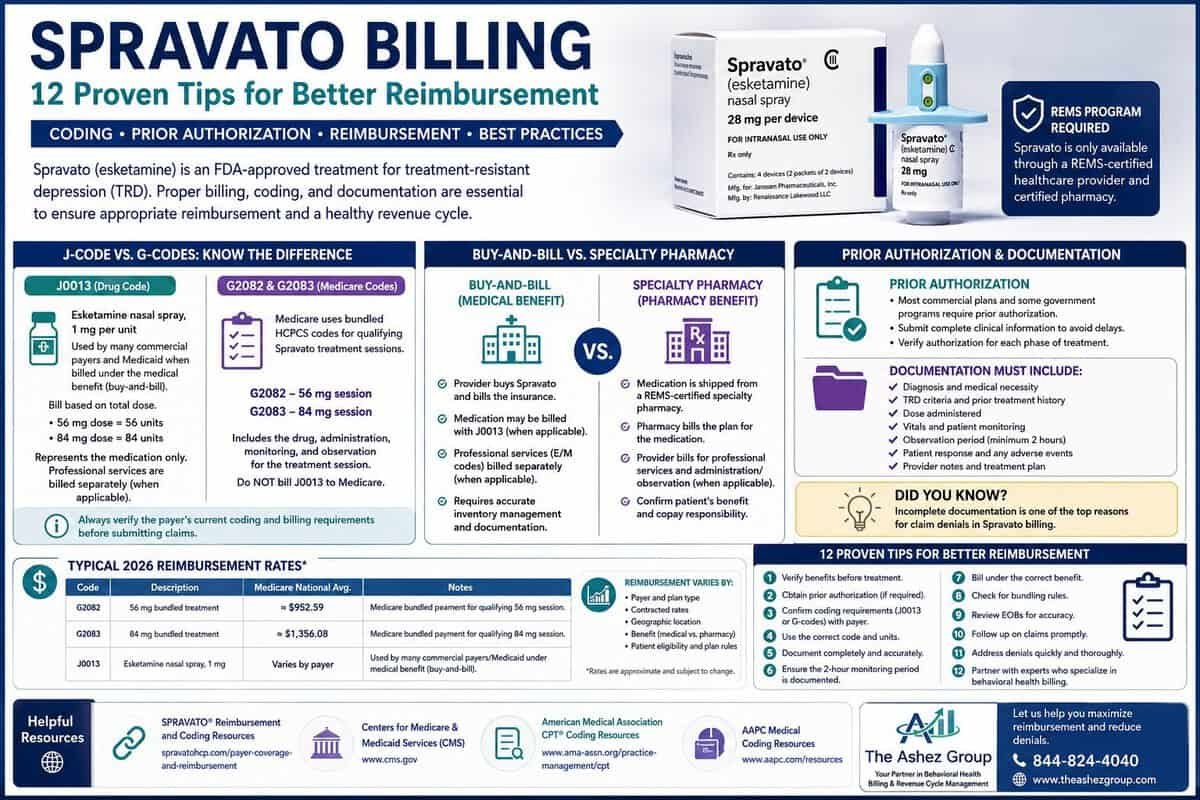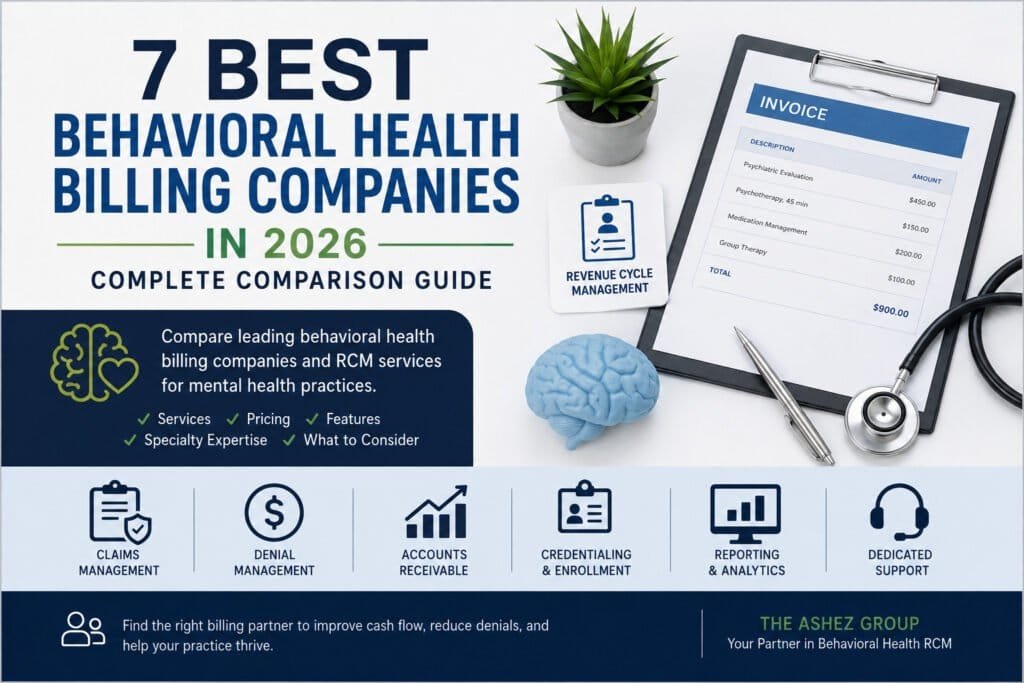
Choosing the right behavioral health billing company can have a major impact on how efficiently a psychiatry, psychology, counseling, or therapy practice manages claims, denials, accounts receivable, credentialing, and payer requirements.
Behavioral health billing has its own challenges. Psychotherapy services, psychiatric E/M services, telehealth, authorization requirements, provider credentialing, payer-specific policies, and documentation requirements can make revenue cycle management particularly complex.
This guide compares several behavioral health billing companies serving U.S. practices in 2026 and explains what providers should evaluate before outsourcing their revenue cycle.
Disclosure: This guide is published by The Ashez Group, which provides behavioral health medical billing and revenue cycle management services. Companies are included based on publicly available information and their relevance to behavioral health practices. Providers should independently evaluate any company before entering into an agreement.
Quick Answer: What Are Some Behavioral Health Billing Companies to Consider in 2026?
Behavioral health practices have several billing and RCM options depending on their size, specialty, technology requirements, and desired level of support.
Companies worth evaluating include:
| Company | Potential Fit | Billing Model | Behavioral Health Focus |
|---|---|---|---|
| The Ashez Group | Independent and growing practices seeking hands-on RCM and credentialing support | Percentage/customized | Strong |
| TheraThink | Therapists and psychiatrists seeking behavioral-health-focused billing | Percentage-based | Strong |
| PGM Billing | Practices wanting an established full-service RCM organization | Customized | Specialty support |
| Plutus Health | Larger organizations seeking technology-enabled RCM | Customized | Specialty division |
| AdvancedMD | Practices wanting billing integrated with practice-management technology | Customized | Multi-specialty |
| Tebra | Independent practices wanting technology plus RCM capabilities | Customized | Multi-specialty |
| Ensora Health | Therapy and behavioral health organizations seeking integrated practice technology | Subscription/service dependent | Strong |
There is no universally “best” behavioral health billing company. The best partner depends on the practice’s provider mix, payer contracts, claim volume, EHR, existing A/R, authorization requirements, reporting needs, and desired level of involvement.
Why Behavioral Health Billing Requires Specialized Knowledge
Behavioral health revenue cycles can involve psychotherapy, psychiatric evaluation and management, behavioral assessments, collaborative care, telehealth and other services.
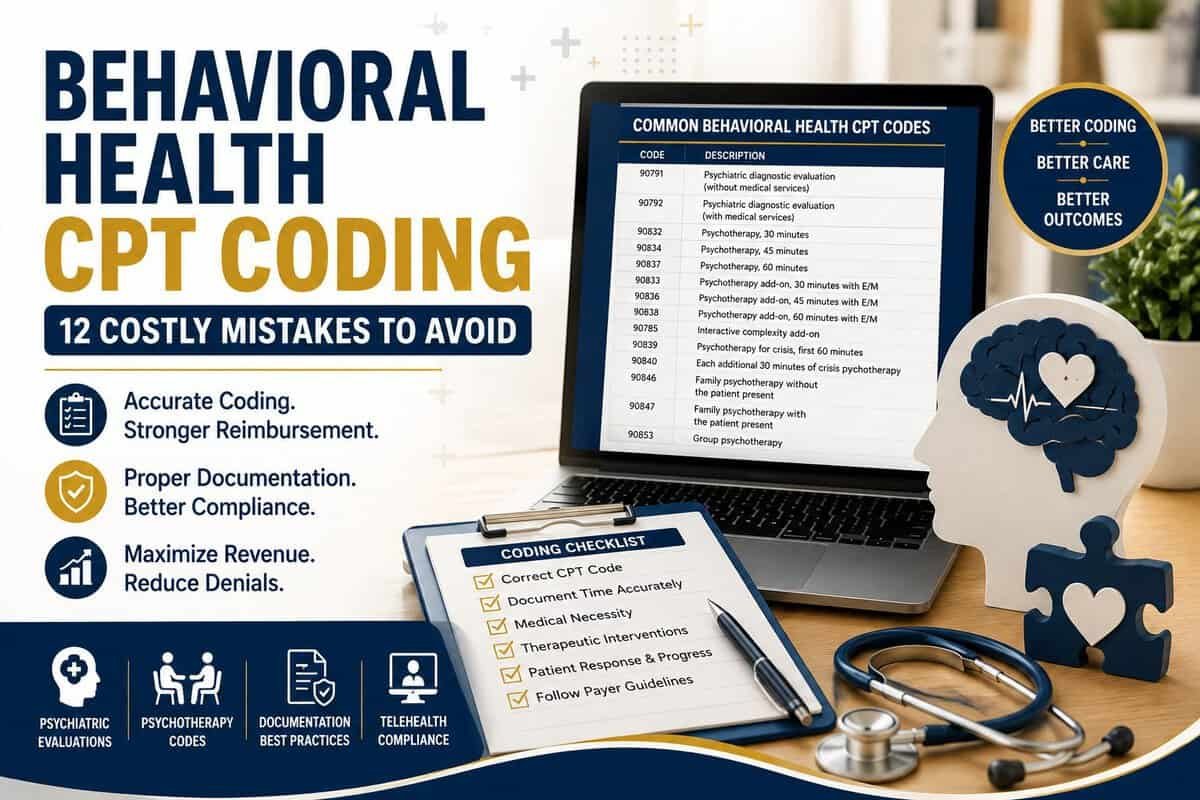
Common CPT codes encountered in behavioral health include:
- 90791 — Psychiatric diagnostic evaluation
- 90792 — Psychiatric diagnostic evaluation with medical services
- 90832 — Psychotherapy, 30 minutes
- 90834 — Psychotherapy, 45 minutes
- 90837 — Psychotherapy, 60 minutes
- 90833 — Psychotherapy add-on with E/M
- 90836 — Psychotherapy add-on with E/M
- 90838 — Psychotherapy add-on with E/M
- 90853 — Group psychotherapy
- 96127 — Brief emotional/behavioral assessment
The American Medical Association also identifies codes for general behavioral health integration and psychiatric collaborative care, including 99484 and 99492–99494.
Coding alone, however, does not determine whether a claim will be paid.
A behavioral health billing operation may also need to manage:
- eligibility and benefits;
- prior authorization;
- provider credentialing;
- payer enrollment;
- telehealth requirements;
- place-of-service reporting;
- claim submission;
- rejection correction;
- denial management;
- appeals;
- payment posting;
- patient responsibility;
- accounts receivable follow-up; and
- payer-specific billing requirements.
For 2026, behavioral health reimbursement continues to evolve. CMS, for example, finalized additional behavioral-health-integration options associated with Advanced Primary Care Management, reinforcing the importance of keeping billing workflows aligned with current payer rules.
How We Evaluated Behavioral Health Billing Companies
Instead of ranking companies solely by marketing claims, practices should compare vendors using consistent criteria.
For this guide, the primary considerations are:
1. Behavioral Health Experience
Does the company routinely work with psychiatrists, psychologists, therapists, counselors, psychiatric nurse practitioners, behavioral health clinics, or similar providers?
2. Revenue Cycle Coverage
A billing partner may provide only claims submission, while another may handle eligibility, coding review, denials, A/R, payment posting, credentialing and reporting.
Understand exactly where the company’s responsibility begins and ends.
3. Denial Management
Ask whether the billing company merely resubmits denied claims or performs root-cause analysis and appeals when appropriate.
4. Accounts Receivable Management
A/R should be actively worked rather than simply reported.
Providers should understand how the company handles:
- 0–30 day A/R;
- 31–60 day A/R;
- 61–90 day A/R;
- 90+ day A/R; and
- timely-filing risks.
5. Credentialing Capabilities
Credentialing and billing are closely connected.
A technically perfect claim can still encounter reimbursement problems when provider enrollment, group affiliation, service location, taxonomy, reassignment or payer configuration is incorrect.
6. Reporting and Transparency
Practices should be able to understand what is happening to their revenue.
Useful reports can include:
- charges;
- payments;
- adjustments;
- denial trends;
- outstanding A/R;
- aging;
- payer performance; and
- unresolved billing issues.
7. Technology Compatibility
Changing EHRs solely to accommodate a billing vendor can create unnecessary disruption.
Ask whether the billing company can work with your existing EHR, practice-management system and clearinghouse.
8. Communication
Find out who actually manages the account.
Ask:
Will we have a dedicated point of contact?
How quickly are billing questions answered?
How frequently will we review performance?
Those operational questions can be more important than the sales presentation.
Behavioral Health Billing Companies to Consider in 2026
1. The Ashez Group
Best fit: Independent behavioral health practices looking for billing, credentialing, denial management and hands-on revenue cycle support.
The Ashez Group provides medical billing and revenue cycle management services to healthcare practices across the United States, including behavioral health organizations.
Behavioral health support can include claim submission, payment posting, denial management, A/R follow-up, insurance verification, credentialing and payer enrollment.
The company works with multiple types of behavioral health professionals and practices, including psychiatrists, psychiatric nurse practitioners, psychologists, therapists and counselors.#billing companies for mental health
Notable Capabilities
- Behavioral health billing
- Psychiatry billing
- Claims management
- Denial management and appeals
- A/R follow-up
- Eligibility and benefits verification
- Credentialing and payer enrollment
- Payment posting
- Reporting
- Telehealth billing support
- Practice administrative support
Potential Advantage
The Ashez Group may be particularly attractive to independent and growing practices that prefer combining billing and credentialing support rather than coordinating multiple vendors.
medical billing services for small practices
Consider Before Choosing
As with any RCM company, practices should request a proposal based on their actual provider count, payer mix, claim volume and required services rather than comparing vendors on headline pricing alone.
Learn more: Behavioral Health Billing Services from The Ashez Group.
2. TheraThink
Best fit: Therapists, counselors, psychologists and psychiatrists seeking a company strongly associated with behavioral health billing.
TheraThink focuses heavily on mental health billing and provides resources aimed at therapists and behavioral health practices.
Its specialization can make it worth considering for providers who want a billing organization familiar with common behavioral health insurance workflows.
Consider TheraThink If:
- behavioral health is your primary specialty;
- you want outsourced insurance billing;
- you operate a solo or small behavioral health practice; or
- you prefer a company strongly focused on mental health.
Practices should confirm current pricing, included services, credentialing support and EHR compatibility directly with the company.
3. PGM Billing
Best fit: Practices wanting an established RCM organization with mental-health billing capabilities.
PGM Billing provides medical billing and revenue cycle services across healthcare specialties, including mental and behavioral health.
Its broader RCM infrastructure may appeal to organizations looking beyond basic claims submission.
Before choosing PGM or another larger RCM company, determine whether your account receives a dedicated behavioral health billing team and how account communication is structured.
4. Plutus Health
Best fit: Growing or larger organizations looking for technology-supported revenue cycle management.
Plutus Health provides RCM services across multiple healthcare specialties and markets behavioral health billing capabilities.
Practices evaluating larger RCM organizations should pay particular attention to implementation, reporting, escalation procedures and who will manage their account after onboarding.
5. AdvancedMD
Best fit: Practices that want billing and practice-management technology within a broader ecosystem.
AdvancedMD differs somewhat from a traditional standalone billing company because its technology platform is a significant part of its offering.
That can make it attractive for practices looking to combine scheduling, practice management, EHR functionality and revenue cycle workflows.
The tradeoff is important: practices should determine whether they primarily need a billing partner or an integrated technology platform.
Those are not necessarily the same purchasing decision.
6. Tebra
Best fit: Independent healthcare practices interested in combining practice technology and revenue cycle capabilities.
Tebra offers technology and services for independent healthcare practices.
Behavioral health practices considering Tebra should compare its workflow and technology ecosystem against specialized billing companies that can operate within the practice’s existing systems.
Neither approach is inherently superior.
The right choice depends on whether the practice wants to change technology or simply outsource its revenue cycle.
7. Ensora Health
Best fit: Behavioral health and therapy organizations interested in integrated practice-management technology.
Ensora Health’s behavioral-health technology ecosystem makes it relevant to practices that want clinical and administrative workflows closely connected.
Organizations should compare the cost and operational implications of an integrated platform with those of maintaining their existing EHR and hiring an independent billing company.
Behavioral Health Billing Company Comparison: Specialized RCM vs. Technology Platforms
One important distinction is often missed when practices compare vendors.
There are roughly two models.
Specialized RCM Partner
The practice keeps its existing clinical technology while outsourcing billing operations.
This can work well when the practice likes its current EHR but needs better revenue-cycle execution.
Integrated Technology + Billing Platform
The practice uses a technology ecosystem that may combine EHR, scheduling, practice management and billing capabilities.
This can reduce the number of systems involved but may also increase dependence on one platform.
Neither model is automatically better.
The correct question is:
Which model solves the actual revenue-cycle problem without creating unnecessary operational disruption?
What Should a Behavioral Health Practice Ask Before Hiring a Billing Company?
Before signing an agreement, ask prospective billing companies:
- How many behavioral health practices do you currently support?
- Which behavioral health provider types do you work with?
- Which services are included in your standard fee?
- Do you charge on insurance collections, total collections or another basis?
- Are credentialing services included?
- Who handles eligibility verification?
- Who handles prior authorizations?
- How are rejected claims handled?
- How are denied claims worked?
- Who files appeals?
- How often is A/R followed up?
- How do you manage claims approaching timely-filing limits?
- Which EHRs and clearinghouses do you support?
- Will our practice have a dedicated point of contact?
- What reports will we receive?
- How often will we meet to discuss performance?
- How is patient information protected?
- What happens to our data if we terminate the agreement?
- Are there setup or termination fees?
- What is the contract termination period?
A provider should be cautious if a prospective billing company cannot clearly answer these questions.
How Much Do Behavioral Health Billing Companies Charge?
There is no single standard fee.
Medical billing arrangements may use:
- percentage of collections;
- flat monthly fees;
- per-claim fees;
- per-provider fees; or
- customized hybrid pricing.
The lowest percentage is not necessarily the least expensive option.
Consider a hypothetical practice choosing between:
Company A: lower percentage but limited denial/A/R support.
Company B: somewhat higher percentage but includes denial management, eligibility, credentialing support and active A/R follow-up.
Company B could potentially provide greater overall value despite the higher headline fee.
Therefore, practices should compare total scope and expected financial impact, not percentage alone.
Warning Signs When Choosing a Medical Billing Company
Providers should investigate further when a company:
- guarantees specific reimbursement outcomes without reviewing the practice;
- cannot explain its denial workflow;
- provides little visibility into A/R;
- cannot identify who will manage the account;
- makes vague claims about HIPAA compliance;
- cannot explain how access to systems and patient information is controlled;
- has unclear termination provisions;
- cannot describe its behavioral health experience; or
- pressures the practice into changing EHRs without a compelling operational reason.
Why Credentialing Matters to Behavioral Health Revenue
Billing and credentialing are sometimes treated as unrelated administrative functions.
Operationally, they are closely connected.
Problems involving payer enrollment, provider information, service locations, taxonomy, group affiliation or network participation can interfere with reimbursement even when a claim is otherwise accurate.
Behavioral health practices should therefore establish a process for monitoring:
- CAQH information;
- payer enrollment;
- recredentialing;
- provider additions and terminations;
- service locations;
- group affiliations; and
- payer portal information.
Practices outsourcing both functions may benefit from having billing and credentialing teams communicate directly when enrollment-related denials occur.
Behavioral Health Billing and Telehealth
Telehealth remains particularly important to behavioral healthcare.
Practices should not assume that one billing configuration works for every payer.
The billing team should verify applicable payer requirements involving:
- eligible services;
- provider eligibility;
- place of service;
- modifiers;
- patient location;
- documentation;
- consent requirements; and
- payer-specific policies.
When payer rules differ, the applicable payer policy should govern the claim rather than a generic billing checklist.
Is Outsourcing Behavioral Health Billing Worth It?
It depends on the practice.
Outsourcing may make sense when:
- providers are spending clinical time on billing;
- claims are not being followed consistently;
- A/R is increasing;
- denials remain unresolved;
- staff turnover affects collections;
- credentialing delays are affecting reimbursement;
- the practice lacks experienced billing staff; or
- leadership cannot clearly determine why revenue is delayed.
Keeping billing in-house may still be appropriate when a practice has experienced staff, strong processes, adequate oversight and consistently healthy revenue-cycle performance.
The goal should not be outsourcing for its own sake.
The goal is a reliable, measurable and accountable revenue cycle.
Frequently Asked Questions
What is the best behavioral health billing company?
There is no single best behavioral health billing company for every practice. The appropriate choice depends on specialty, practice size, payer mix, EHR, claim volume, credentialing requirements, A/R condition, pricing and the level of support required.
What does a behavioral health billing company do?
A behavioral health billing company can manage claims submission, payment posting, denial management, appeals, accounts receivable follow-up, eligibility verification, credentialing, reporting and other revenue-cycle functions depending on the agreement.
Do behavioral health billing companies handle credentialing?
Some do and some do not. Practices should determine whether credentialing is included, offered separately or handled by another organization.
Can a billing company work with my existing EHR?
Many billing companies can work within existing EHR and practice-management systems, while some technology-centered organizations work best within their own platforms. Confirm compatibility before signing an agreement.
Should psychiatrists use a specialized billing company?
Psychiatrists frequently bill a combination of psychiatric diagnostic services, E/M services and psychotherapy add-on services. A billing company familiar with these workflows may be beneficial, particularly when the practice also handles telehealth, multiple payers or complex credentialing.
What should I look for in a mental health billing company?
Look for behavioral health experience, transparent reporting, denial management, active A/R follow-up, payer knowledge, technology compatibility, credentialing capabilities, data-security processes and clear communication.
How do I know whether my current billing company is performing well?
Review metrics and trends such as claim rejections, denials, payment delays, A/R aging, unresolved claims, write-offs and payer-specific problems. Performance should be evaluated over time rather than based on a single month’s collections.
Choosing the Right Behavioral Health Billing Partner
The best behavioral health billing company is not necessarily the largest provider, the cheapest provider or the company appearing first in a search result.
It is the organization capable of managing the specific revenue-cycle challenges of your practice while providing sufficient transparency to demonstrate what is happening to every dollar billed.
Before choosing a company, document your current problems.
Is the issue:
Denials?
Aging A/R?
Credentialing?
Prior authorizations?
Staffing?
Eligibility?
Reporting?
All of the above?
Once the problem is defined, comparing billing companies becomes considerably easier.
Need a Second Look at Your Behavioral Health Revenue Cycle?
The Ashez Group provides medical billing, credentialing, denial management, A/R follow-up and revenue cycle support for behavioral health practices.
Rather than changing vendors based solely on a percentage or sales presentation, start by identifying where revenue is being delayed.
Request a billing analysis from The Ashez Group
A review of your current workflow can help identify denial patterns, aging A/R, credentialing issues and other revenue-cycle gaps before you decide what to change.
Behavioral Health CPT Coding: 12…