Credentialing vs Contracting is one of the most common areas of confusion for healthcare providers enrolling with insurance companies. Although the terms are often used interchangeably, they represent two distinct processes that determine whether you can participate in a payer’s network and how you’ll be reimbursed for your services.
Whether you’re opening a new practice, adding providers, or expanding into new insurance networks, understanding the difference between credentialing and contracting is essential. Completing credentialing does not automatically mean you’re contracted with a payer, and misunderstanding this can lead to claim denials, payment delays, and lost revenue.
In this guide, we’ll explain how credentialing and contracting work together, highlight their key differences, and share best practices to help you complete the provider enrollment process successfully.
What Is Provider Credentialing?
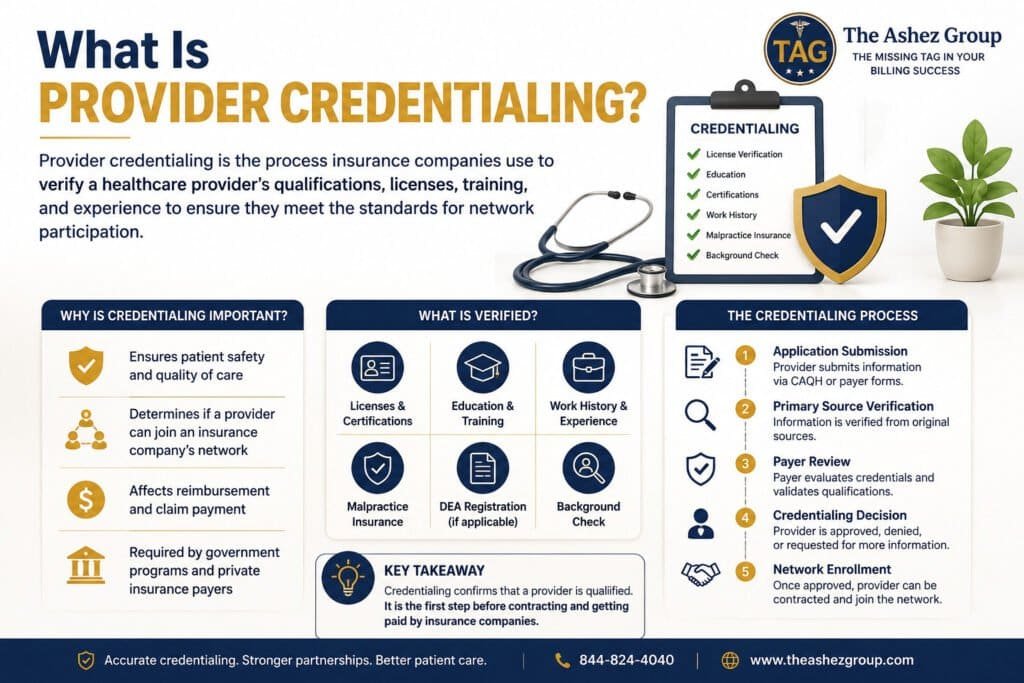
Provider credentialing is the process insurance companies use to verify a healthcare provider’s qualifications before allowing participation in their network.
During credentialing, payers review information such as:
- Professional licenses
- Board certifications
- Education and training
- Work history
- DEA registration (when applicable)
- NPI information
- CAQH profile
- Malpractice insurance
- Sanction and exclusion checks
The purpose is to ensure providers meet the payer’s standards for quality and compliance before treating members as an in-network provider.
What Is Insurance Contracting?
Insurance contracting begins after—or sometimes alongside—the credentialing process.
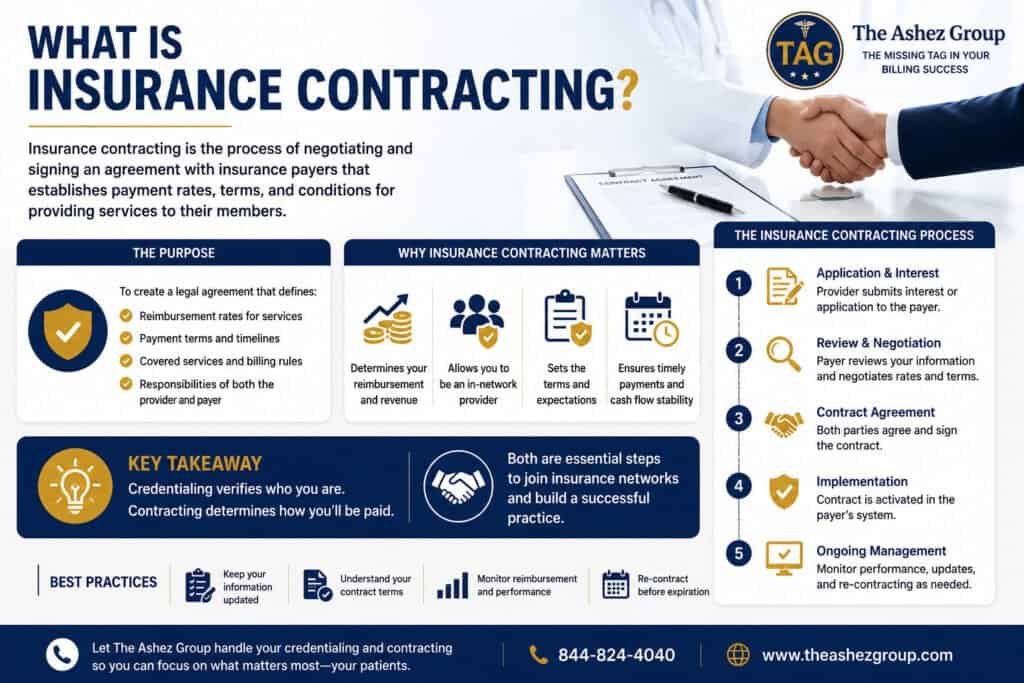
Contracting establishes the legal business relationship between the healthcare provider (or practice) and the insurance company.
A provider contract typically outlines:
- Reimbursement rates
- Covered services
- Billing requirements
- Timely filing limits
- Appeals process
- Payment terms
- Termination clauses
- Compliance obligations
Without a signed contract, providers may not receive negotiated in-network reimbursement, even if they have completed credentialing.
Credentialing vs. Contracting: The Biggest Difference
The easiest way to understand the distinction is this:
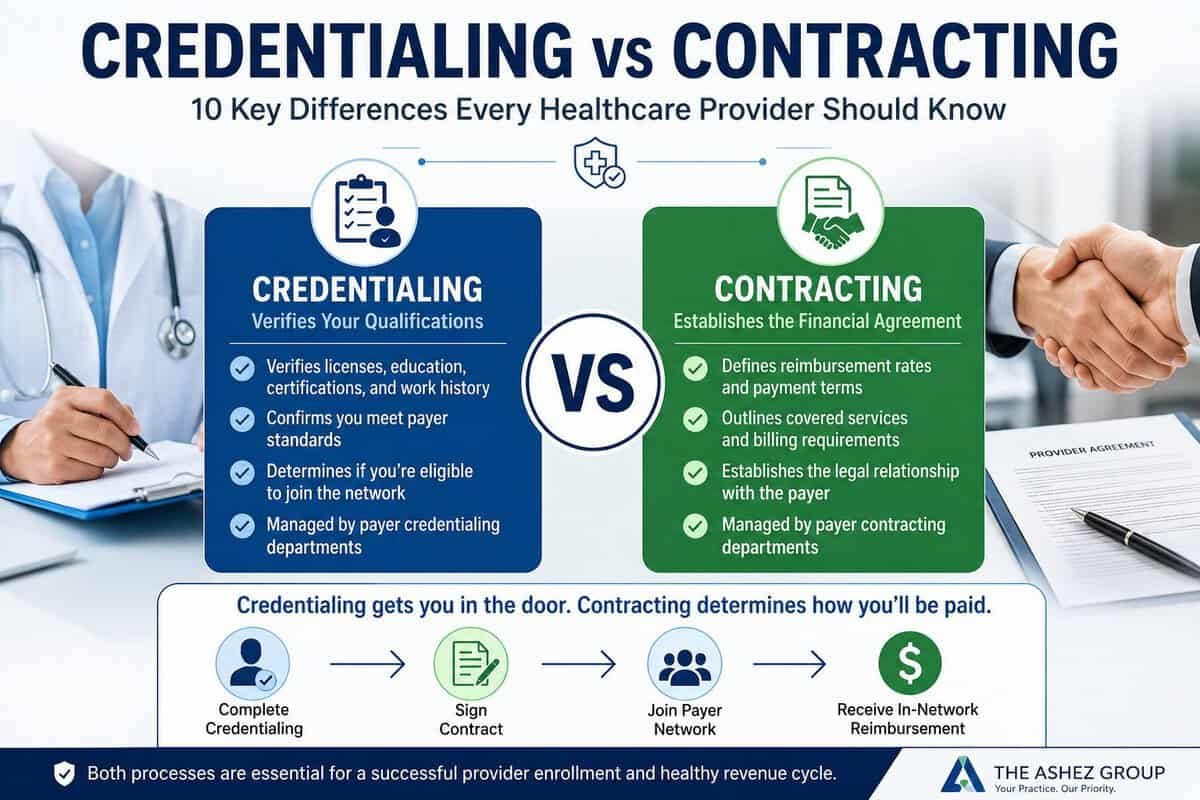
Credentialing determines whether you’re qualified to join the network.
Contracting determines how you’ll be paid after joining the network.
Think of credentialing as earning admission to the network, while contracting establishes the financial and legal agreement that governs your participation.
Both processes are necessary to become a fully participating in-network provider with most commercial insurance companies.
Why Providers Often Confuse the Two
Many providers assume that once an insurance company approves their credentialing application, they can immediately begin billing as an in-network provider.
Unfortunately, that’s not always the case.
Some payers require a separate contract to be executed before the provider is officially considered in-network. Billing before the effective date of the contract can lead to:
- Out-of-network reimbursement
- Claim denials
- Payment delays
- Patient billing issues
- Revenue loss
Understanding the distinction helps practices avoid costly enrollment mistakes and ensures services are billed under the correct network status.
Why Both Processes Matter for Revenue Cycle Management
Credentialing and contracting directly affect your revenue cycle.
If either process is delayed or incomplete, practices may experience:
- Delayed claim payments
- Increased denials
- Lost revenue
- Patient dissatisfaction
- Administrative rework
Establishing an organized enrollment workflow helps providers avoid interruptions in cash flow while maintaining compliance with payer requirements.
The Shift to Telehealth: Transforming Medical Billing Strategies and Challenges. #insurance credentialing and contracting #the difference between credentialing #is the difference
Differences Between Credentialing and Contracting
Although credentialing and contracting are closely connected, they serve different purposes in the provider enrollment process. Understanding these distinctions helps healthcare providers avoid delays in becoming in-network and receiving proper reimbursement.
| Credentialing | Contracting |
|---|---|
| Verifies provider qualifications | Establishes the financial agreement with the payer |
| Reviews licenses, education, certifications, and work history | Defines reimbursement rates and payment terms |
| Focuses on provider eligibility | Focuses on business and legal terms |
| Required before joining most payer networks | Required to receive negotiated in-network reimbursement |
| Managed by payer credentialing departments | Managed by payer contracting departments |
| May involve CAQH and primary source verification | Involves reviewing and signing participation agreements |
| Typically takes 60–180 days | Usually completed after or alongside credentialing |
| Determines if a provider qualifies | Determines how and when a provider gets paid |
| Does not establish reimbursement rates | Establishes fee schedules and contract obligations |
| Must be maintained through recredentialing | Contracts require periodic review and renewal |
How Long Does Each Process Take?
While timelines vary by payer, here’s a general expectation:
Credentialing
- Medicare: Approximately 60–90 days
- Commercial insurance: 90–180 days
- Medicaid: Varies by state, often 60–120 days
Contracting
- May take 30–90 days after credentialing approval.
- Some payers complete contracting simultaneously, while others begin only after credentialing is finalized.
Starting both processes as early as possible helps reduce delays in seeing patients as an in-network provider.
Common Mistakes Providers Make
Many reimbursement issues occur because providers misunderstand the enrollment process. Common mistakes include:
- Assuming credentialing automatically includes contracting.
- Seeing patients before the contract effective date.
- Allowing CAQH information to expire.
- Failing to submit updated licenses or malpractice insurance.
- Not reviewing reimbursement rates before signing contracts.
- Missing payer enrollment deadlines.
- Ignoring contract renewal notices.
These oversights can lead to delayed payments, denied claims, or out-of-network reimbursement.
Best Practices for Faster Provider Enrollment
To improve the enrollment process and avoid unnecessary delays:
✔ Keep your CAQH profile complete and attested regularly.
✔ Maintain current licenses, certifications, malpractice insurance, and DEA registration (if applicable).
✔ Respond promptly to payer requests for additional documentation.
✔ Track credentialing and contracting status for every insurance company.
✔ Review reimbursement schedules before signing any participation agreement.
✔ Recredential before expiration dates to prevent network interruptions.
✔ Maintain organized enrollment records for future audits and renewals.
Why Credentialing and Contracting Matter
Provider enrollment is one of the most important steps in building a financially successful healthcare practice.
Without credentialing, providers generally cannot participate in payer networks. Without contracting, they may not receive negotiated in-network reimbursement—even if credentialing has been approved.
Completing both processes correctly helps practices:
- Reduce payment delays
- Prevent claim denials
- Improve cash flow
- Expand insurance participation
- Maintain compliance with payer requirements
- Deliver a smoother experience for patients
Final Thoughts
Credentialing and contracting are often mentioned together, but they are not the same process. Credentialing confirms that a provider meets a payer’s qualifications, while contracting establishes the legal and financial terms for participating in that payer’s network.
Understanding both processes—and ensuring each is completed accurately—can help providers avoid costly enrollment mistakes, minimize reimbursement delays, and build a stronger revenue cycle.
Whether you’re opening a new practice, adding providers, or expanding into new insurance networks, a well-managed credentialing and contracting strategy is essential for long-term success.
What is provider credentialing?
Provider credentialing is the process insurance companies use to verify a healthcare provider's qualifications, including licenses, education, certifications, work history, and malpractice coverage before allowing participation in their network.
How are provider credentialing and contracting different?
Credentialing verifies that a provider meets a payer's requirements, while contracting establishes the legal agreement, reimbursement rates, and payment terms between the provider and the insurance company.
3. How long does provider credentialing take?
Credentialing timelines vary by payer but typically range from 60 to 180 days. Medicare often takes 60–90 days, while commercial insurance plans may require several months.
4. Does credentialing mean I am automatically in-network?
No. Credentialing alone does not make you an in-network provider. Most insurance companies also require a signed participation contract before you receive in-network reimbursement.
5. What documents are required for provider credentialing?
Common requirements include your professional license, NPI, CAQH profile, board certifications, DEA registration (if applicable), malpractice insurance, work history, and education records.
6. What happens if my credentialing expires?
Expired credentialing can result in claim denials, payment delays, or removal from an insurance network. Providers should complete recredentialing before their current approval expires.
7. Why is CAQH important for provider credentialing?
CAQH serves as a centralized repository for provider information. Many commercial insurance companies use it to streamline credentialing and reduce duplicate paperwork.
8. Can I bill insurance while my credentialing is pending?
In most cases, providers should wait until credentialing and contracting are complete and the effective date has been confirmed by the payer before billing as an in-network provider.
9. Why do healthcare providers outsource credentialing?
Many providers outsource credentialing to reduce administrative workload, avoid enrollment delays, improve accuracy, and accelerate participation with insurance networks.
10. How can The Ashez Group help with provider credentialing?
The Ashez Group manages the credentialing and payer enrollment process from start to finish, including CAQH management, Medicare and commercial payer enrollment, application tracking, follow-ups, and recredentialing support to help providers join insurance networks faster.