Every healthcare practice expects some level of revenue loss. Insurance contracts, unpaid patient balances, and regulatory requirements all contribute to financial adjustments throughout the revenue cycle.
However, not every write-off is unavoidable.
Many healthcare providers unknowingly lose thousands of dollars every year because preventable billing issues go unnoticed. Claim denials, inaccurate coding, missed filing deadlines, and poor accounts receivable follow-up often result in unnecessary medical billing write-offs that directly reduce practice profitability.
Understanding the difference between normal contractual write-offs and preventable revenue loss is one of the most effective ways to improve financial performance.
In this guide, we’ll explain what medical billing write-offs are, why they happen, which write-offs are expected, and how healthcare providers can reduce avoidable revenue loss through stronger revenue cycle management.
What Are Medical Billing Write-Offs?
Medical billing write-offs are reductions in the amount a healthcare provider expects to collect for services rendered.
Once a balance is written off, it is generally removed from Accounts Receivable because the practice has determined it is no longer collectible or must be adjusted based on contractual obligations.
Write-offs fall into two broad categories:
- Contractual write-offs (expected)
- Preventable write-offs (avoidable)
Understanding the difference is critical for maintaining healthy medical practice cash flow.
Why Medical Billing Write-Offs Matter
Many practice owners closely monitor claim denials but overlook write-offs.
Over time, even small write-offs can significantly reduce annual revenue.
High write-off rates may indicate:
- Revenue leakage
- Billing workflow issues
- Documentation deficiencies
- Coding errors
- Weak collection processes
- Poor denial management
Tracking write-offs provides valuable insight into the overall health of your revenue cycle.
Contractual Write-Offs vs. Preventable Write-Offs
Not every write-off represents a financial mistake.
Contractual Write-Offs
These occur because providers have negotiated reimbursement rates with insurance companies.
For example:
- Medicare fee schedules
- Commercial insurance contracts
- Medicaid reimbursement limits
- PPO negotiated rates
These adjustments are expected and should be accurately recorded.
Contractual write-offs are largely determined by reimbursement rules established through payer contracts and programs such as the Centers for Medicare & Medicaid Services (CMS)
Preventable Write-Offs
Preventable write-offs occur when reimbursement is lost because of operational or billing issues.
Examples include:
- Timely filing denials
- Missing documentation
- Coding errors
- Eligibility verification failures
- Missed appeal deadlines
- Poor accounts receivable follow-up
Unlike contractual adjustments, these losses can often be reduced through stronger billing processes.
1. Timely Filing Deadlines Were Missed
Insurance companies enforce strict filing deadlines.
Claims submitted after the allowable filing period are frequently denied with little opportunity for payment.
Missing filing deadlines often results from:
- Delayed charge entry
- Workflow bottlenecks
- Staffing shortages
- Manual billing processes
Submitting claims promptly is one of the easiest ways to reduce preventable write-offs.
2. Insurance Eligibility Was Never Verified
Eligibility verification is the first step in protecting practice revenue.
When insurance coverage is inactive or incorrect, providers may never receive reimbursement.
Common issues include:
- Expired coverage
- Incorrect policy information
- Coordination of benefits errors
- Patient demographic mistakes
Verifying benefits before every appointment reduces billing errors and minimizes unnecessary write-offs.
3. Claim Denials Were Never Appealed
Not every denied claim should be written off.
Many claims are recoverable through timely appeal.
Unfortunately, busy practices sometimes write off denied claims instead of investigating why they were denied.
An effective denial management process should:
- Review denial reasons
- Correct billing errors
- Gather supporting documentation
- Submit appeals before payer deadlines
Recovering even a small percentage of denied claims can significantly improve annual revenue.
4. Coding Errors Reduced Reimbursement
Incorrect CPT, ICD-10, or HCPCS coding can result in:
- Claim denials
- Downcoding
- Underpayments
- Payment delays
- Complete write-offs
Routine coding audits help identify recurring issues and improve claim accuracy before submission.
Staying current with American Medical Association CPT® Coding Resources helps providers improve coding accuracy and reduce preventable write-offs.
5. Poor Accounts Receivable Follow-Up
Outstanding claims should never be ignored.
Practices that fail to follow up on unpaid balances often lose reimbursement simply because no action was taken.
Effective A/R management includes:
- Weekly aging reports
- Insurance follow-up
- Patient balance reviews
- Payment tracking
- Escalation of unresolved claims
Consistent follow-up helps prevent collectible revenue from becoming unnecessary write-offs.
6. Missing Prior Authorizations
Many insurance plans require prior authorization before certain services, procedures, imaging studies, or medications are provided.
If authorization is missing or expires before treatment, the payer may deny the claim entirely, leaving the practice with little or no reimbursement.
Common causes include:
- Authorization requests submitted too late
- Incorrect procedure codes
- Expired authorizations
- Missing authorization numbers
- Failure to verify payer requirements
Implementing a standardized prior authorization workflow helps reduce preventable write-offs and improves reimbursement accuracy.
7. Patient Balances Were Never Collected
Insurance reimbursement is only one part of the revenue cycle.
Patient responsibility—including deductibles, copayments, and coinsurance—must also be collected efficiently.
Many practices lose revenue because:
- Statements are sent too late
- Payment plans aren’t offered
- Patient balances aren’t followed up
- Contact information is outdated
Collecting patient responsibility at the time of service whenever possible significantly reduces bad debt write-offs.
8. Documentation Didn’t Support the Service
Insurance companies expect every billed service to be supported by clear clinical documentation.
Incomplete or inconsistent documentation may result in:
- Downcoding
- Claim denials
- Medical necessity rejections
- Payment reductions
Providers should ensure documentation includes:
- Chief complaint
- Clinical findings
- Medical decision-making
- Treatment provided
- Provider signature
Strong documentation protects reimbursement while reducing audit risk.
9. Inefficient Revenue Cycle Processes
Revenue cycle management involves every step from patient scheduling to final payment collection.
When even one stage breaks down, revenue suffers.
Practices should regularly evaluate:
- Patient registration
- Insurance verification
- Charge capture
- Coding accuracy
- Claim submission
- Payment posting
- Denial management
- Accounts receivable follow-up
Improving these processes reduces revenue leakage and strengthens financial performance.
#revenue cycle management
10. No One Was Monitoring Write-Off Trends
Many healthcare organizations review monthly collections but fail to analyze write-off reports.
Monitoring write-off trends helps identify recurring problems before they become costly.
Look for patterns involving:
- Specific insurance carriers
- Certain CPT codes
- Individual providers
- Particular denial reasons
- Patient balance collections
Regular reporting enables leadership to make informed operational decisions.
11. Lack of Revenue Cycle Performance Metrics
Healthcare practices that don’t measure performance often miss opportunities for improvement.
Important KPIs include:
Net Collection Rate
Measures how much collectible revenue the practice actually receives.
Days in Accounts Receivable (A/R)
Indicates how quickly claims are converted into cash.
Clean Claim Rate
Measures the percentage of claims accepted without corrections.
Claim Denial Rate
Tracks denied claims requiring follow-up or appeal.
Write-Off Percentage
Monitors total revenue removed from Accounts Receivable.
Tracking these indicators provides early warning signs of operational issues.
How to Reduce Preventable Medical Billing Write-Offs
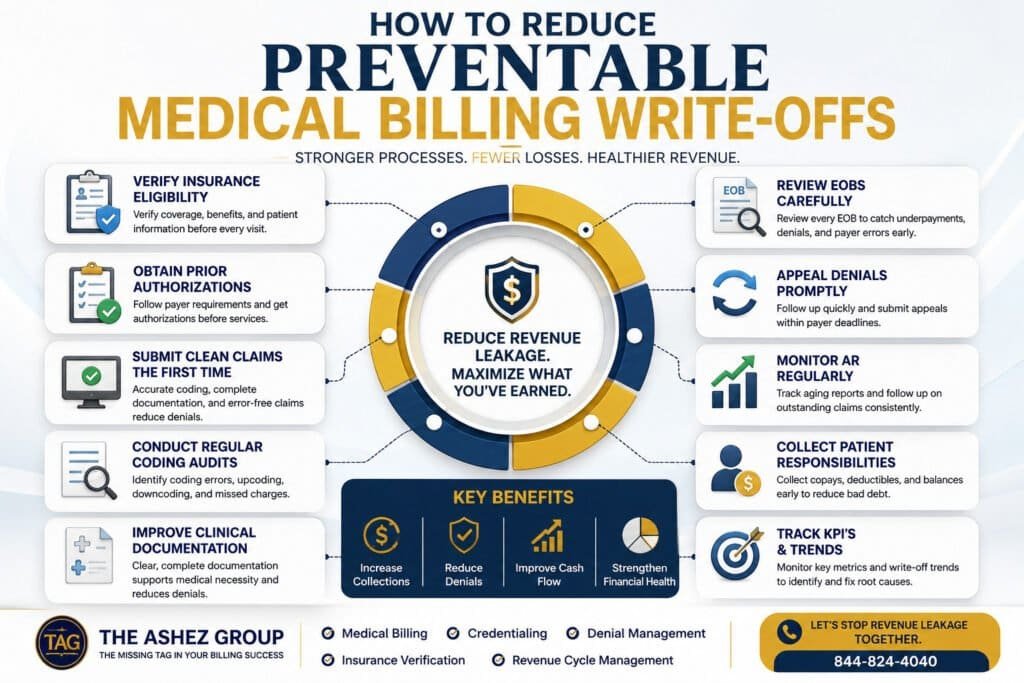
Preventing unnecessary write-offs requires a proactive approach to revenue cycle management.
Healthcare providers should:
✔ Verify insurance eligibility before every visit
✔ Obtain required prior authorizations
✔ Submit clean claims promptly
✔ Perform routine coding audits
✔ Improve clinical documentation
✔ Review Explanation of Benefits (EOBs)
✔ Appeal eligible claim denials
✔ Monitor Accounts Receivable weekly
✔ Track revenue cycle KPIs
✔ Analyze write-off reports monthly
Small improvements in daily workflows often produce significant financial gains over time.
Regular education through AAPC Medical Coding Resources helps billing teams stay informed about coding updates and compliance best practices.
#write off in medical billing #types of writeoffs in medical #adjustment in medical billing #Medical billing compliance
Why Revenue Cycle Management Is the Key to Reducing Write-Offs
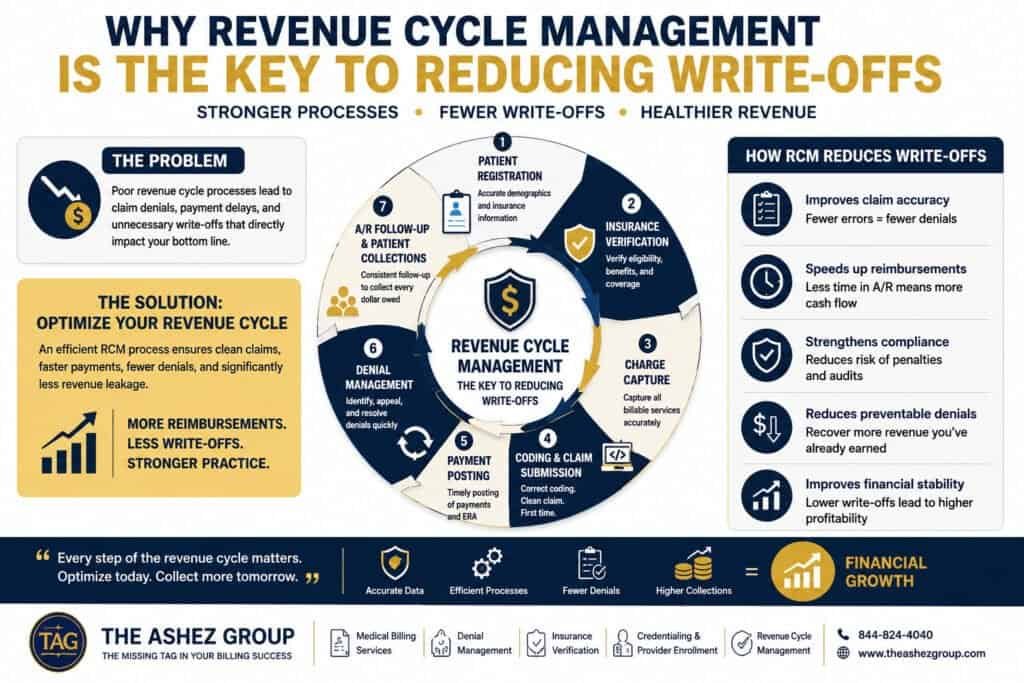
Every preventable write-off represents revenue that could have been collected with stronger operational processes.
Effective revenue cycle management helps healthcare organizations:
- Improve reimbursement accuracy
- Reduce billing errors
- Increase clean claim rates
- Recover denied claims
- Strengthen compliance
- Improve medical practice cash flow
- Reduce revenue leakage
By optimizing each stage of the revenue cycle, practices can retain more of the revenue they’ve earned while reducing unnecessary administrative costs.
#medical billing what
Final Thoughts
Not all medical billing write-offs are avoidable. Contractual adjustments are a normal part of healthcare reimbursement and should be expected as part of payer agreements.
However, preventable write-offs—including missed filing deadlines, coding errors, poor documentation, denied claims, and inadequate accounts receivable follow-up—represent opportunities for meaningful financial improvement.
Healthcare organizations that regularly review write-off reports, monitor key revenue cycle metrics, and strengthen billing workflows are better positioned to reduce revenue leakage and improve long-term profitability.
At The Ashez Group, we help healthcare providers nationwide identify preventable revenue loss through comprehensive medical billing, coding support, denial management, insurance verification, provider credentialing, and revenue cycle management services. Our goal is simple: help practices collect every dollar they have earned while maintaining compliance and operational efficiency.
Reducing write-offs isn’t just about increasing revenue—it’s about building a healthier, more sustainable healthcare practice for the future.
Frequently Asked Questions (FAQs)