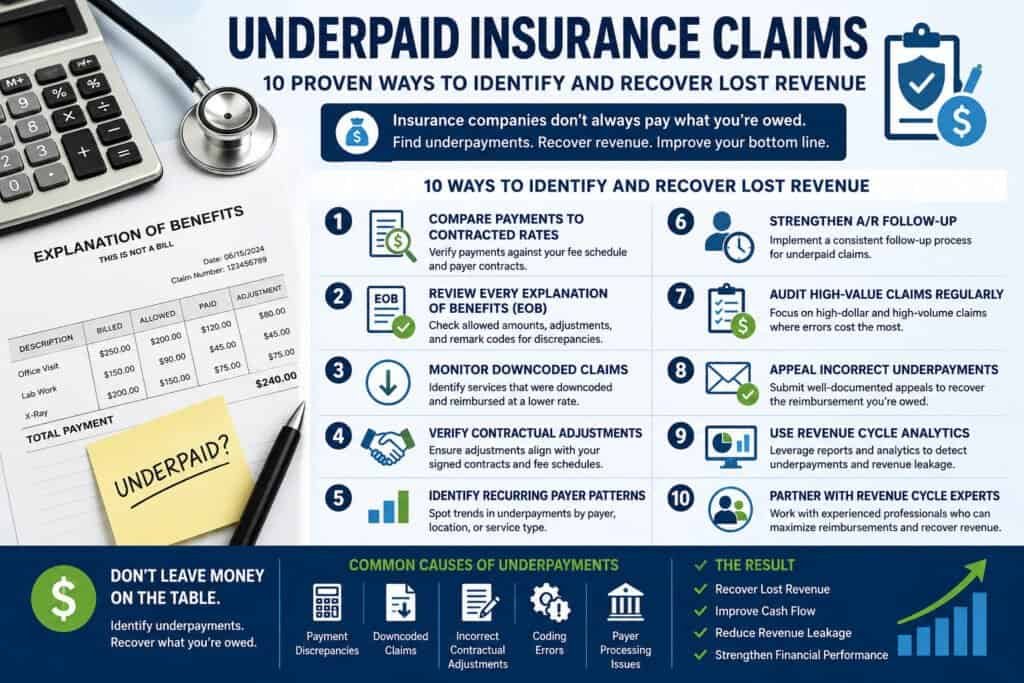
Most healthcare providers pay close attention to claim denials, but far fewer monitor claims that are paid incorrectly.
An insurance company may process your claim, issue payment, and close the case—yet your practice could still receive less reimbursement than it deserves.
These are known as underpaid insurance claims, and they represent one of the largest sources of hidden revenue leakage in healthcare.
Unlike denied claims, underpayments often go unnoticed because payment has already been received. Over time, these small reimbursement differences can add up to thousands—or even hundreds of thousands—of dollars in lost revenue for busy medical practices.
The good news is that many underpayments can be identified and corrected with proactive revenue cycle management, payment analysis, and timely appeals.
In this guide, you’ll learn what underpaid insurance claims are, why they happen, and ten practical ways to recover lost revenue while improving your practice’s financial performance.
#insurance companies underpay claims #do insurance companies underpay #insurance claim was underpaid
What Are Underpaid Insurance Claims?
Underpaid insurance claims occur when an insurance company reimburses less than the amount a healthcare provider is contractually or legally entitled to receive.
Unlike claim denials, underpaid claims receive payment—but the reimbursement does not match the expected allowable amount based on the provider’s contract, fee schedule, or payer policies.
Common examples include:
- Incorrect payment calculations
- Downcoded CPT services
- Missing reimbursement for billable procedures
- Incorrect contractual adjustments
- Bundled services that should have been paid separately
Because these claims appear as “paid,” they are frequently overlooked during routine payment posting.
Healthcare providers should review reimbursement guidance from the Centers for Medicare & Medicaid Services (CMS)
Why Underpaid Insurance Claims Matter
Even small payment discrepancies can significantly impact your practice over time.
For example, if a payer underpays just $40 per claim across 300 claims each month, your practice could lose more than $144,000 annually.
Underpayments affect:
- Practice profitability
- Medical practice cash flow
- Accounts Receivable performance
- Provider productivity
- Long-term financial stability
Identifying underpayments is just as important as reducing claim denials.
#insurance claim is underpaid #bad faith insurance #request appraisal file a complaint #Why do insurance companies underpay claims?
1. Compare Payments to Contracted Rates
The first step in identifying underpaid insurance claims is comparing every reimbursement against your contracted fee schedule.
Insurance companies occasionally make payment errors because of:
- Incorrect fee schedules
- Contract updates
- System processing errors
- Manual payment adjustments
Automated contract management tools can help practices quickly identify reimbursement discrepancies.
2. Review Every Explanation of Benefits (EOB)
Many providers focus only on whether payment was received.
Instead, carefully review each Explanation of Benefits (EOB) to verify:
- Allowed amount
- Paid amount
- Patient responsibility
- Adjustment codes
- Remark codes
Unexpected reductions often reveal hidden underpayments.
3. Monitor Downcoded Claims
One of the most common causes of underpaid insurance claims is claim downcoding.
Insurance companies may reduce reimbursement by assigning a lower-paying CPT code when documentation is considered insufficient.
Monitor recurring patterns involving:
- Evaluation and Management (E/M) services
- Surgical procedures
- Therapy services
- Behavioral health visits
Frequent downcoding should trigger documentation and coding reviews.
4. Verify Contractual Adjustments
Not every contractual adjustment is correct.
Practices should periodically verify:
- Fee schedules
- Contract amendments
- Annual payer updates
- Negotiated reimbursement rates
Incorrect contractual adjustments may result in thousands of dollars of preventable revenue loss each year.
5. Identify Recurring Payer Patterns
Sometimes the issue isn’t a single claim it’s a specific insurance carrier.
Revenue cycle reports can reveal patterns such as:
- Repeated underpayments
- Frequent downcoding
- Incorrect modifier reductions
- Delayed reimbursements
- Specific CPT codes consistently paid below contract
Recognizing payer trends allows practices to address problems before they become long-term financial losses.
6. Strengthen Accounts Receivable (A/R) Follow-Up
One of the biggest reasons underpaid insurance claims remain unresolved is a lack of consistent follow-up.
Many healthcare practices focus on unpaid claims while overlooking claims that were paid incorrectly.
An effective A/R follow-up process should include:
- Weekly payment reviews
- Underpayment reports
- Payer follow-up
- Escalation of unresolved claims
- Appeal tracking
The sooner underpayments are identified, the greater the chance of recovering the remaining balance.
7. Audit High-Value Claims Regularly
Not every claim requires an in-depth review.
Instead, prioritize audits for:
- High-dollar procedures
- Surgical claims
- Behavioral health services
- Specialty procedures
- High-volume CPT codes
Even a small reimbursement error on high-value claims can significantly impact annual revenue.
Routine payment audits help identify trends before they become costly.
8. Appeal Incorrect Underpayments
Receiving partial payment doesn’t always mean the reimbursement is correct.
If the payer has not followed the provider agreement or applicable payment policies, practices should submit an appeal.
A successful appeal typically includes:
- The original claim
- Explanation of Benefits (EOB)
- Supporting documentation
- Contracted fee schedule
- Medical records (if requested)
- A clear explanation of the payment discrepancy
Many underpayments can be recovered when supported by complete documentation.
9. Use Revenue Cycle Analytics
Modern revenue cycle management systems make it easier to identify payment trends.
Useful reports include:
Underpayment Reports
Identify claims paid below contracted rates.
Payer Performance Reports
Compare reimbursement accuracy across insurance carriers.
Contract Compliance Reports
Detect incorrect contractual adjustments.
Revenue Leakage Reports
Highlight recurring financial losses before they affect profitability.
Using data to monitor reimbursement performance allows practices to address problems proactively rather than reactively.
10. Partner With Revenue Cycle Experts
Recovering underpaid insurance claims requires more than reviewing EOBs.
Experienced revenue cycle specialists help practices:
- Review payer contracts
- Identify underpayments
- Analyze payment trends
- Strengthen coding accuracy
- Appeal reimbursement discrepancies
- Improve collections
- Reduce future revenue leakage
Working with experienced billing professionals allows providers to focus on patient care while maximizing earned revenue.
Best Practices to Prevent Underpaid Insurance Claims
Reducing underpayments starts with strong operational processes.
Healthcare organizations should:
✔ Verify payer contracts annually
✔ Monitor contracted reimbursement rates
✔ Review every Explanation of Benefits (EOB)
✔ Audit high-value claims
✔ Improve clinical documentation
✔ Perform routine coding audits
✔ Track payer performance
✔ Appeal payment discrepancies promptly
✔ Monitor revenue cycle KPIs
✔ Train billing staff on payer policy updates
Small improvements throughout the revenue cycle often result in significant long-term financial gains.
Key Revenue Cycle Metrics to Monitor
Practices should regularly monitor:
Net Collection Rate
Measures how much collectible revenue is successfully received.
Days in Accounts Receivable (A/R)
Tracks how quickly insurance payments are collected.
Clean Claim Rate
Indicates the percentage of claims accepted without corrections.
Underpayment Rate
Measures the percentage of claims reimbursed below contracted amounts.
First-Pass Payment Rate
Shows how many claims are paid correctly on the initial submission.
Monitoring these KPIs helps identify reimbursement problems before they become major financial losses.
Why Revenue Cycle Management Is Essential
Strong revenue cycle management is the foundation of accurate reimbursement.
An effective revenue cycle helps healthcare providers:
- Reduce insurance underpayments
- Improve reimbursement accuracy
- Increase collections
- Reduce claim denials
- Strengthen cash flow
- Minimize revenue leakage
- Improve operational efficiency
Practices that continuously evaluate their billing performance are better positioned to recover earned revenue and maintain long-term financial stability.
Final Thoughts
Underpaid insurance claims often represent hidden revenue loss because they are paid—but not paid correctly.
By comparing payments against contracted rates, reviewing Explanation of Benefits (EOBs), auditing high-value claims, monitoring payer trends, and appealing incorrect reimbursements, healthcare providers can recover significant revenue that might otherwise be overlooked.
A proactive approach to revenue cycle management not only improves collections but also strengthens financial performance, reduces administrative burdens, and supports sustainable practice growth.
At The Ashez Group, we help healthcare providers nationwide identify underpaid insurance claims, recover lost revenue, optimize reimbursement accuracy, and improve every stage of the revenue cycle through expert medical billing, denial management, insurance verification, credentialing, and revenue cycle management services.
Every correctly reimbursed claim helps strengthen your practice’s financial future.
Frequently Asked Questions (FAQs)
Underpaid insurance claims are claims that receive payment, but the reimbursement is less than the amount the provider is entitled to under the payer contract or fee schedule.
Common reasons include downcoding, incorrect contractual adjustments, coding errors, payer processing mistakes, and outdated fee schedules.
Compare payments against your contracted rates, review Explanation of Benefits (EOBs), monitor payment trends, and audit high-value claims.
Yes. If the payment doesn’t match your contract or payer policy, you can submit an appeal with supporting documentation and reimbursement details.
Underpaid claims reduce cash flow, increase revenue leakage, and lower overall profitability, especially when payment discrepancies go unnoticed.
A denied claim receives no payment, while an underpaid claim is paid—but at a lower amount than expected.
Regular payment audits, accurate coding, strong documentation, contract reviews, and proactive revenue cycle management help reduce underpayments.
The Ashez Group helps healthcare providers identify payment discrepancies, recover lost revenue, appeal underpaid claims, and optimize reimbursement through comprehensive revenue cycle management services.