
Medical Billing Lost Revenue Calculator
Free Revenue Analysis
• Healthcare Practices
• Nationwide
What Is Revenue Leakage in Medical Billing?
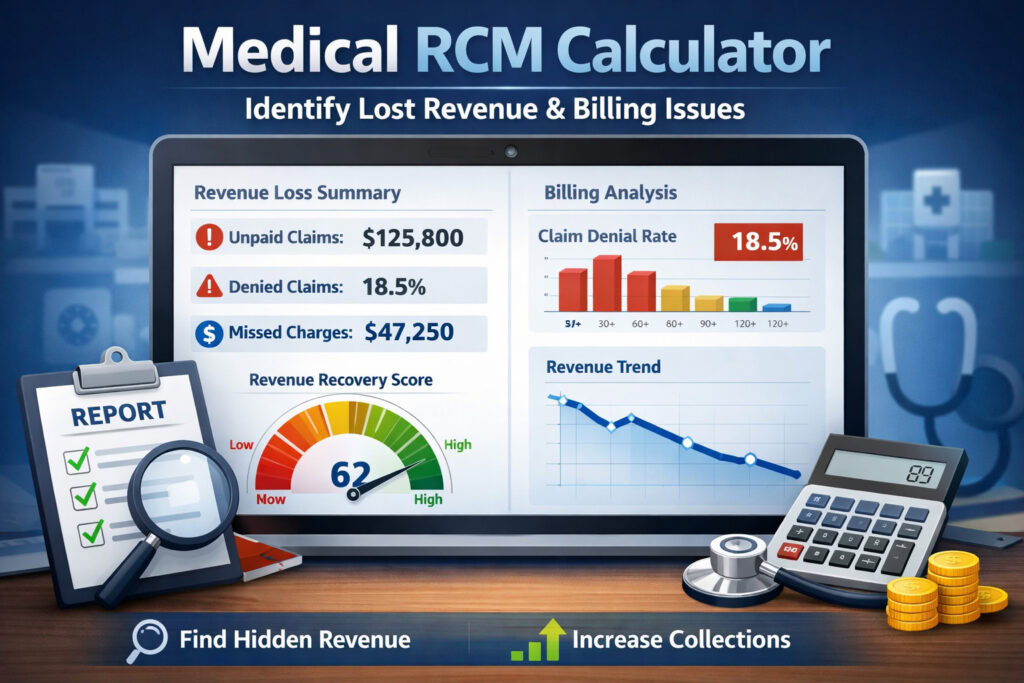
Healthcare revenue leakage occurs when revenue associated with services provided is delayed, reduced, written off, or not collected because of issues within the revenue cycle.
Revenue leakage may be associated with:
- Claim denials and rejections
- Insurance underpayments
- Aging accounts receivable
- Eligibility and coverage issues
- Missing prior authorizations
- Coding or modifier issues
- Credentialing and payer-enrollment problems
- Timely filing issues
- Missed or incomplete charges
- Unresolved payer balances
A revenue leakage calculator can provide an initial estimate, but identifying the actual cause generally requires reviewing claims, denials, A/R, payer responses, and billing workflows.
Our RCM Calculator helps identify areas for improvement and ensures you’re maximizing profitability.
Learn more about healthcare claims and billing through CMS Medicare Coding & Billing resources
Monthly Revenue Calculator
Here’s Your Revenue Breakdown:
- Average Monthly Collection:
- Estimated Total Monthly Revenue Loss:
- Estimated Revenue Growth:
Thanks ! Our team will reach out shortly to help you grow your revenue.
Why Medical Practices Lose Revenue
Revenue loss doesn’t always begin when a claim is denied. Problems can develop at different stages of the revenue cycle.
Eligibility & Benefits Issues
Incorrect or incomplete insurance information can create billing problems before a claim is submitted.
Prior Authorization Problems
Services requiring authorization may experience denials or delays when payer requirements aren’t completed appropriately.
Claim Denials
Denied claims that aren’t corrected, appealed, or followed through to resolution can contribute to aging A/R.
Insurance Underpayments
Payments may require review when reimbursement differs from expected or contracted amounts.
Aging Accounts Receivable
Claims remaining unresolved for extended periods can become increasingly difficult to collect.
Credentialing & Enrollment Issues
Provider, location, group, or payer-enrollment problems can interfere with claim processing and reimbursement.
How the Lost Revenue Calculator Works
Our Medical Billing Lost Revenue Calculator uses the billing and collection information entered by your practice to estimate potential revenue that may be affected by revenue cycle issues. Simply enter the requested practice and billing information into the calculator. The tool evaluates the information provided and generates an estimated view of potential revenue loss. Results are estimates and can vary based on specialty, payer mix, claim volume, reimbursement, billing performance, and other practice-specific factors.
Understanding Your Lost Revenue Estimate
The result from our healthcare revenue calculator should be viewed as an estimate rather than a guaranteed amount of recoverable revenue. A calculated revenue gap may indicate that it is worth taking a closer look at areas such as: Denial trends — Which payers and denial reasons are creating the most unresolved claims? A/R aging — How much insurance A/R is sitting beyond 60, 90, or 120 days? Underpayments — Are payer reimbursements being reviewed for unexpected payment differences? Eligibility & authorization — Are front-end issues contributing to downstream denials? Credentialing — Are provider enrollment or practice-location issues affecting claims? Payer follow-up — Are unresolved claims consistently assigned a clear next action? The calculator identifies a potential financial issue. A detailed revenue-cycle review can help determine where the issue is occurring.
What Should You Do After Using the Calculator?
If your medical practice revenue calculator indicates potential lost revenue, don't assume every dollar shown is recoverable.Instead, review the underlying revenue cycle.
Identify unpaid insurance balances and determine which claims still require action.
Group denials by payer, reason, provider, and service to identify recurring problems.
Compare applicable payments with expected reimbursement when appropriate.
Review eligibility, benefits, authorization, referrals, demographics, and insurance information.
Confirm providers, groups, specialties, and service locations are appropriately enrolled where required.
Every unresolved insurance balance should have a documented next step.
Turn Your Estimate Into Action
The calculator provides an estimate. The next step is understanding why revenue may be getting delayed or lost.
The Ashez Group provides medical billing and revenue cycle management support for healthcare practices, including:
Medical Billing & Claim Submission
Denial Management & Appeals
A/R Follow-Up & Revenue Recovery
Eligibility & Benefits Verification
Prior Authorization Support
Provider Credentialing & Payer Enrollment
Payment Posting
Revenue Cycle Reporting
Want a Closer Look at Your Revenue Cycle?
Let our team review your billing challenges and discuss where additional revenue-cycle support may make sense.
844-824-4040
Discover how much revenue you’re losing — and how to recover it.
Medical Billing Metrics Worth Monitoring
A strong medical revenue cycle management process involves more than looking at monthly collections.
Healthcare practices should regularly review metrics such as:
Monitor how frequently claims are denied and identify recurring denial categories.
Compare billing and insurance collections over time to identify unexpected changes.
Evaluate payment delays, denial patterns, and outstanding balances by payer.
Track claims affected by missing, expired, or mismatched authorization information.
Identify claims affected by provider enrollment, location, group, or payer-participation problems. These metrics provide more context than collections alone and can help practices identify areas requiring further investigation.
FAQs About Medical Billing Lost Revenue
A medical billing lost revenue calculator is a tool designed to estimate potential revenue loss based on practice billing and collection information. It can help healthcare providers identify whether their revenue cycle may warrant further review.
Common causes can include claim denials, underpayments, aging A/R, eligibility problems, missing authorizations, credentialing issues, timely filing, and incomplete billing workflows.
Yes. The Ashez Group's Medical Billing Lost Revenue Calculator is available to healthcare practices as a free online tool.
No. Calculator results are estimates and should not be interpreted as guaranteed recoverable revenue. Actual results depend on individual claims, payer requirements, documentation, filing deadlines, contractual terms, and other factors.
Practices can review denial trends, aging A/R, payer payments, underpayments, authorization issues, credentialing problems, and unresolved insurance balances to identify potential areas of revenue leakage.
Practices can strengthen eligibility verification, authorization tracking, claim review, denial management, payer follow-up, credentialing, payment review, and A/R workflows to address issues contributing to delayed or lost revenue.
A review may be useful when a practice experiences growing A/R, recurring denials, unexplained payment differences, credentialing problems, delayed claims, or difficulty determining why insurance balances remain unresolved.